The City’s Own Report Demonstrates People Could Die.
The City, Fearing the State, Approved the Project Anyway.
We Sued. The petition: saratogacred.org
Never Forget
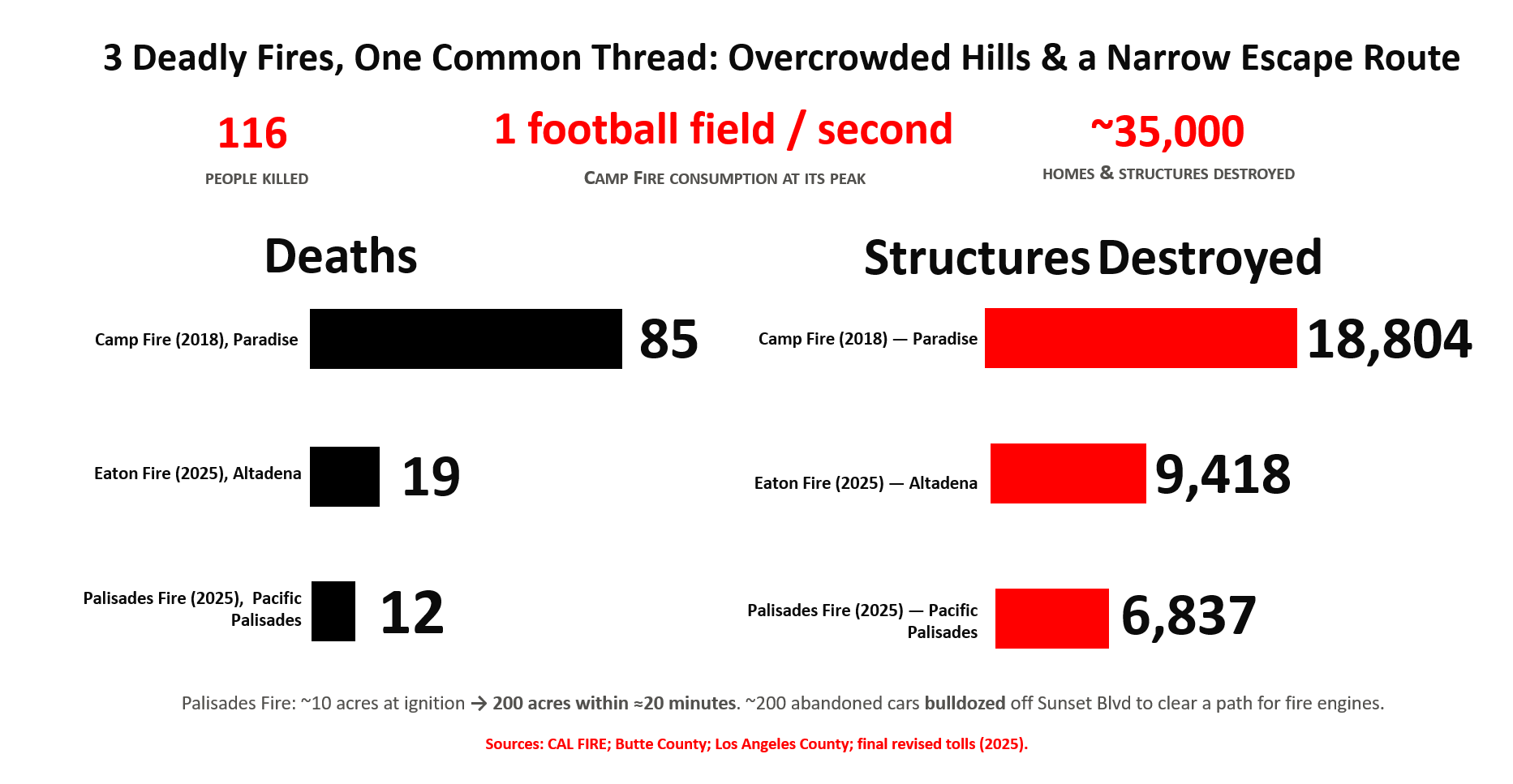
On November 8, 2018, the Camp Fire overran Paradise, California. At its peak, the fire consumed the equivalent of one football field every second. Eighty-five people died, some in their cars, trapped in the gridlock created by poor escape routes.
There were just too few roads out of town while the fire moved faster than traffic. In addition to the 85 people who horrifically lost their lives, nearly 19,000 homes and structures burned.
Have we already forgotten? On January 7, 2025, the Palisades Fire ignited at about 10:30 a.m. on about 10 acres. Within twenty minutes, the fire grew to 200 acres. A hellscape ensued.
Fire outran evacuation almost immediately. Residents became stuck in gridlock on Sunset Boulevard and had to abandon their cars to flee on foot. Bulldozers were then needed to shove hundreds of abandoned vehicles off the road so the fire engines could get through.
That same day, the Eaton fire erupted in Altadena. It would kill 19 people and take down 9,416 structures.
Across the Palisades and Eaton fires, 31 people lost their lives, and more than 16,000 structures were destroyed. 100,000 people were displaced.
The one common thread for all three fires was overdevelopment in fire-prone hills. Hills that were and are designated very high fire hazard zones. In each case, narrow evacuation routes jammed, and the fires moved faster than 116 people could run, leading to unimaginable horrors.
35,000 homes and structures were burned down.
After the Paradise fire in 2018, the California Legislature passed AB 747, which required cities to analyze whether their roads could handle mass evacuation.
The bill said it plain. Planning for mass evacuation in advance “will help save lives.” The lesson is literally written into state law.
That is, before adding people and structures to a fire-prone hillside, prove that they can get out faster than the fire consumes the area..
The city of Saratoga, California did the study. The study said the winding two-lane road out of the mountains, Pierce Road, already fails as an evacuation route.
Residents will take five hours to get out, the study said
The fire will take four, it said. That should make everyone’s heart skip a beat.
Nevertheless, August 19, the Council approved a 25-home subdivision called Masson Estates on an undeveloped, wooded hillside that CAL FIRE designates a Very High Fire Hazard Severity Zone.
Before voting yes, the Council adopted this finding,
“The proposed Project would cause irreversible environmental changes associated with its significant and unavoidable impacts, namely: impacts related to… emergency access, emergency response and evacuation, wildfire hazards, consistency with an emergency response/evacuation plan, and exposure of project occupants to pollutant concentrations from wildfire.”
The City knew the danger, wrote it down, and approved the project anyway.
Another beat skipped.
On September 18, our 501(c)(3) nonprofit, Citizens for Responsible and Equitable Development (CRED), filed suit in Santa Clara County Superior Court. CRED v. City of Saratoga, Case No. 26CV503751.
The verified petition is at saratogacred.org.
The Record, Briefly
The site sits at Pierce Road and Saratoga Heights Drive. Pierce Road is a narrow, curving two-lane mountain road with steep grades, blind curves and minimal shoulders. Residents of the foothills must travel this road every day and are familiar with it.
I live at the base of Pierce Road. I see them come and go all day long, in orderly if busy fashion. I have been back there, up there to visit friends. I know what is up there.
A tinderbox.
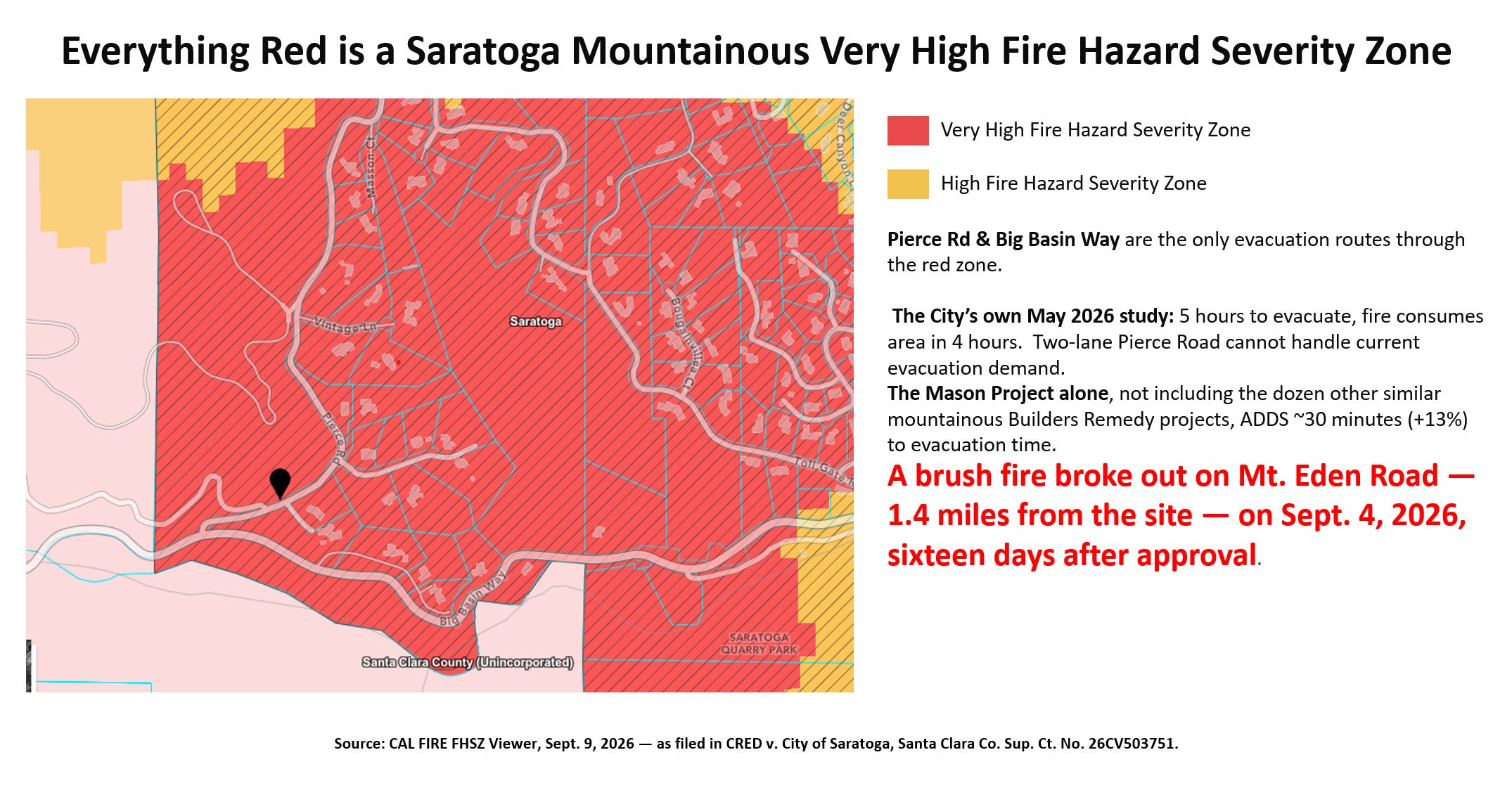
Again, the City of Saratoga’s own modeling shows Pierce Road cannot handle current evacuation demand. Today, without any new projects. They know this, and approved new development anyway.
How marginal is this road?
Almost unbelievably bad as a road, let alone as an escape route.
The City’s own Public Works Department, reviewing this very application in January 2024, required the developer to design and build a stabilizing structure for “existing ground movement.”
Yes, Public Works called out an active landslide on Pierce Road along the project’s own frontage., requiring a storm drain redesign with full width reinforcement above.
Too, the City’s own evacuation study (Fehr & Peers, May 2026) projected the project would add roughly 30 minutes to evacuation time in the event of a fire. This is a 13% increase over baseline.
KLD, a nationally recognized evacuation expert, reviewed that study at our behest and concluded the extra delay could prove pivotal to escaping residents.
The delay “directly increase[s] the likelihood of vehicles becoming trapped on constrained corridors like Pierce Road, creating a critical life-safety hazard and significantly elevating the potential for catastrophic loss of life.“
Vehicles trapped on a constrained corridor do not exist only in these modeling exercises.
We have the evidence, the 85 lives lost in Paradise, the hundreds of cars that needed to be bulldozed off Sunset Boulevard.
Pierce Road cannot be any better and appears even worse, now, than those escape routes were before their fires.
I am a UCLA Bruin, and I can tell you firsthand, little ol’ Pierce Road is no Sunset Boulevard.
KLD’s study concluded that allowing dense development along Pierce Road and the branches off it up into the hills, under the modeled fire conditions, “creates a significant threat to human life,” and that these delays are “major, life-threatening impacts that must be fully addressed before any further development approvals are granted.”
On July 8, the City’s own Planning Commission denied the project as benefits were not found to outweigh the evacuation risk. The developer, of course, appealed.
Six weeks later, the City Council reversed their decision.
Council members stated on the record they approved the project due to fear of legal retribution from either the State’s housing agency or the developer or both.
Surprise, in America, fear of the State is not a legal reason for a City Council to approve a project unsafe for existing residents.
Sixteen days after approval, on September 4, a brush fire broke out on Mt. Eden Road, 1.4 miles from the site. Winds were light. It was contained. Winds are not always so light, especially during fire season.
The City Council’s fear of legal retribution is, simply, not the law of the land.
The Housing Accountability Act itself - Gov. Code § 65589.5(d)(2)- permits a city to deny a housing project that would have a specific, adverse, unavoidable impact on public health or safety.
Section 65589.5(e) expressly preserves California Environmental Quality Act (CEQA), and the predicate findings are the City’s owns: the certified Environmental Impact Report (EIR), and the commissioned Fehr & Peers evacuation study.
The City had the power to say no. It said yes. In doing so, it called non sequitur remediation such as a public trail and a retaining wall “overriding considerations” that somehow outweighed documented risks to human life.
Our lawsuit recites what the fact pattern and record say in their entireties.
The approval violates CEQA, which California courts have repeatedly held requires honest analysis of wildfire evacuation before homes go into the wildland-urban interface.
It violates the Subdivision Map Act, which requires denial of a subdivision likely to cause serious public health problems (Gov. Code § 66474(f)).
An unnecessary extreme fire hazard in a residential community is a public nuisance.
The development poses a threat to life from fire according to the City itself and therefore violates Article I, Section 1 of the California Constitution, which names “obtaining safety” among the inalienable rights of all citizens. Even Saratoga mountain dwellers.
What “Affordable Housing” Means Here
First, honesty about the affordability crisis, because it is real. The Bay Area has priced out its own teachers, nurses, firefighters and service workers. These are people that often commute hours from the remote Central Valley because no housing near their jobs is within reach. Anyone who dismisses that is not serious. When my son worked at Applied Materials in Santa Clara, a fellow worker of his was living out of his car in the parking lot.
We founded CRED in part to insist that new housing here be truly affordable. And we judge these hillside projects by that standard.
Masson Estates is a builder’s remedy project. This means that because Saratoga’s housing element was not certified by the State of Calfornia in July 2023, developers from all over could claim the City lost the power to apply its own zoning rules. That is some valuable immunity that developers have long sought and never quite achieved.
Today, that immunity is in most circumstances state-sanctioned, as long as twenty percent of the homes are “affordable” units. This is the core problem, a fraught question, and it starts with the definition of “affordable.”
At Masson, five homes out of the 25 will be “affordable” and squeezed on lots as small as ~2100 square feet, while the 20 market-rate homes run to 7,000+ square feet on lots up to two acres.
Interestingly, the application grew from 21 homes to 25 between the preliminary and formal filings; SB 330 voids vested rights above a 20% increase, and 21 × 1.2 = 25.2. The developer is building to the regulatory maximum number of units.
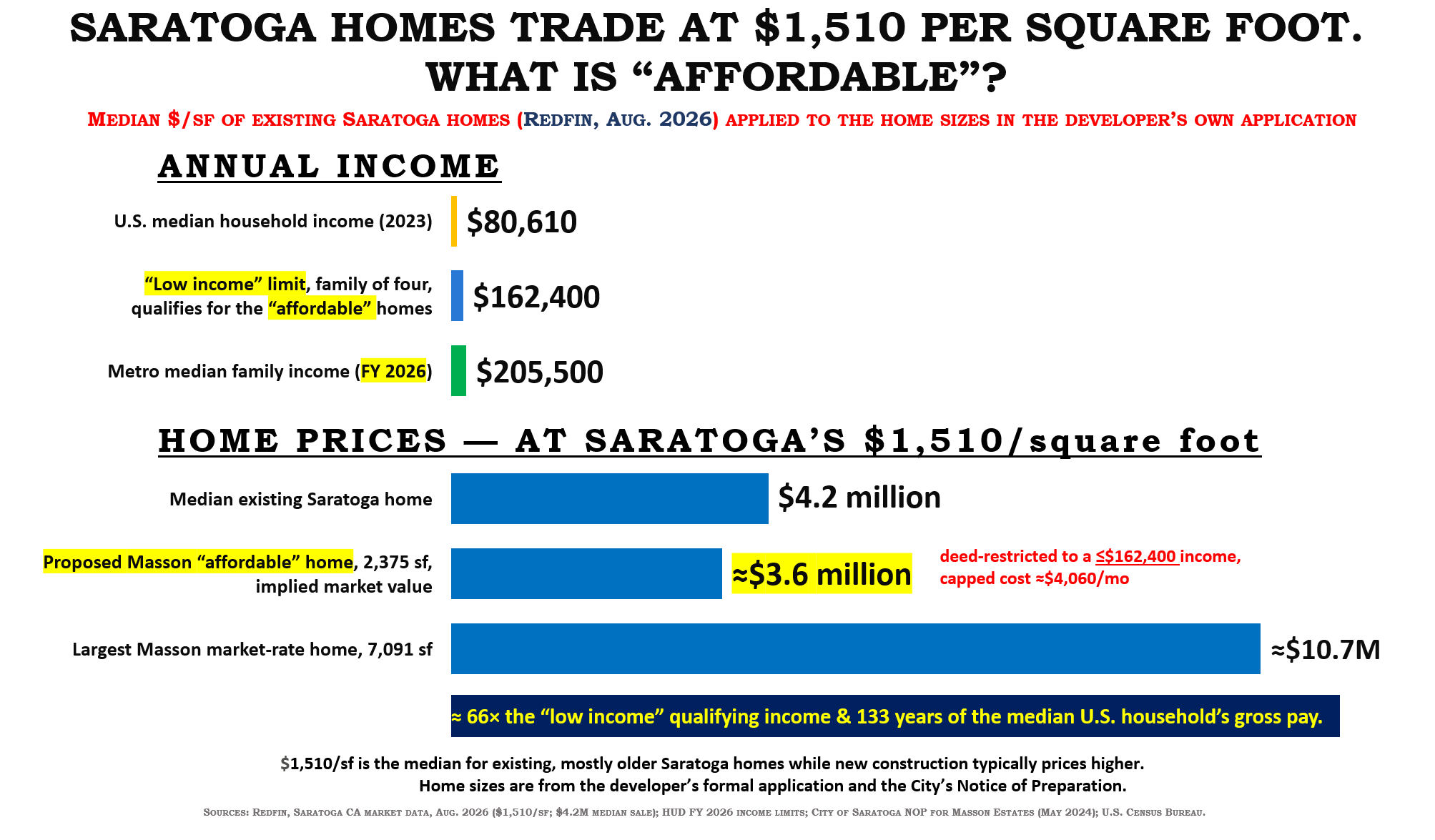
All bars on that visual above are on the same scale.
Take a moment and draw that in.
Now look at what “affordable” means in those 5 homes. State law defines the tier as “lower-income households” which is up to 80% of area median income. The median family income in the San Jose/Sunnyvale/Santa Clara metro area is $205,500.
This is the highest in America because this area and the surrounding foothills is the Valley in Silicon Valley.
Saratoga along with Los Gatos and Cupertino are in the foothills of the Santa Cruz mountains and all are roughly half in half out of the mountains.
Saratoga has plenty of open space not in the mountains. Saratoga tried to build out equitable affordable housing there, but the State said no.
The outside developers that long wanted a piece of Silicon Valley wanted to develop luxury homes in the mountains most of all. The State of California saw an opportunity and arranged that, on behalf of the developers. Builder’s Remedy.
In any event, “low income” here in Silicon Valley means a family of four earning up to $162,400, which is double the median American household’s income. Low income is also a single earner making $113,700 or less, also well above the national average.
The capped housing cost for a qualifying low income family runs near 30% of that income which at the top end is about $4,000 a month.
The Masson Estates “affordable” housing will be ~2400 square foot four-bedroom houses on prime real estate with a view. These are not modest units, but they are “affordable housing” that will sell for $3-$4 million per.
The developers will make out wonderfully, with that kind of home going on a lot slightly smaller than the house at 2100 square feet.
And that is what this is. A boondoggle for developers of unaffordable housing. State sanctioned with full immunity from zoning laws in the name of equity. That is not equity, and it is time someone called them out on it. Building multi-million dollar homes in very high fire hazard zones at the expense of residentts’ safety is no moral high ground..
Existing Saratoga homes, which are mostly 4-5 decades old, tend to sell at a median of $1,510 per square foot. At a planned 7,091 square feet, that pencils out to roughly $10.7 million, which is about 66 times the “low income” qualifying income, or 133 years of the median American household’s gross pay.
The twenty market-rate homes together will likely hit near or above $100 million, and selling five slightly less expensive but still roughly $3.6 million dollar homes is the entire “price” paid by the developers and builders here.
For the very-low and extremely-low income tiers, these projects these deliver zero units. Not fewer. Zero.
If the goal were affordable housing, you would build it where affordable housing works: the valley floor, near transit, main roads, jobs, schools and fire stations.
The “builder’s remedy” law as practiced in Saratoga’s hills is not an affordable housing program.
It is a mansion-entitlement program sited where the state’s own fire maps say no one should add people.
Masson is Not Alone on This Road
Documents CRED obtained through Public Records Act requests show details behind what’s queued for development in the same mountains with the same narrow escape road.
To wit, the Masson Estates developer is co-owner of the Mountain Winery in the same area, but just outside Saratoga’s limits. Still inside the very high fire risk area, the developer is looking at a 255-unit, 81-room-hotel redevelopment of the winery property. Construction has begun.
At 12991 Pierce Road, roughly two dozen three-story homes are proposed on a 1.96-acre parcel dropping to Calabazas Creek. The developer is claiming they should be entitled to a CEQA “infill” exemption and subject to no environmental review at all.
On Mt. Eden Road, where the September 4 brush fire broke out, a 7-unit builder’s remedy application was deemed complete in December 2024.
Then there is Chadwick Heights, a Builder’s Remedy project of 97 units of dense housing - fourplexes, townhomes, duplexes - proposed on 25 hillside acres that the City’s own geotechnical consultant described as essentially an ancient landslide inside a landslide hazard zone. There are actually active visible slides on the property.
The developer’s solution is to move over 800,000 cubic yards of earth with cuts 90 feet deep and fills 70 feet high to prop up the landslide it would build on. This is also to divert creeks on site into culverts, as protecting the creeks is “not feasible given the amount of grading.” , and to run the site’s creeks through culverts, because protecting them is “not feasible given the amount of grading.”
Saratoga’s municipal code limits hillside grading to 1,000 cubic yards.
vs. 800,000.
There are others like this all acrosss the state.
It is a free for all thanks to fear of the State of California.
The City’s own study says Pierce Road fails at today’s population. Masson Estates’ 70 new evacuees are the down payment on a corridor with more than 400 units queued behind them. A free for all.
Why We Fight
We established CRED to give residents a voice against overdevelopment in the fire-prone Saratoga hills. The affordability crisis cannot be solved by siting new tinderboxes in Very High Fire Hazard Severity Zones at the top of evacuation routes that already are failing and projected to fail in the event of a fire.
This is, ironically, developing and building, parcel by parcel, the exact configuration and circumstances that killed 116 people and erased 35,000 homes and structures in Paradise, Pacific Palisades and Altadena.
The City’s own EIR also found significant, unavoidable danger to the future occupants of the project itself.
As well, the people most endangered in any evacuation are those without cars, dependent on transit that will not come up a gridlocked mountain road while the hillside burns.
City Hall fears developers. It fears the State. It fears well-funded pressure groups.
Fear of the State has displaced Saratoga’s duty to its own residents, who are left holding their constitutional right to safety as the soft target.
This is playing out all over the state. I have no doubt, from what I am seeing here, that the seeds are being planted for the next horrific deadly fire nighmare, and the next, and the next, and the next...
For 18 months, across numerous City Council meetings, CRED made its case in public.
Our lawsuit, on behalf of public safety, now speaks for itself.
The petition:
Michael Burry, M.D.
President, Citizens for Responsible and Equitable Development (CRED)
Cassandra Unchained is the literary and analytical home of Dr. Michael Burry. Sign up to receive new full length articles, Trading Posts, Chat Discussion access, and more. The best and possibly largest Chat community on Substack - you have to see it to believe it.