On Saturday, I shared the original text of Warsh's speech at Jackson Hole in both Chinese and English in the group, suggesting everyone read the original. One group member replied:
"What we understand doesn't matter; it depends on how Wall Street understands it."
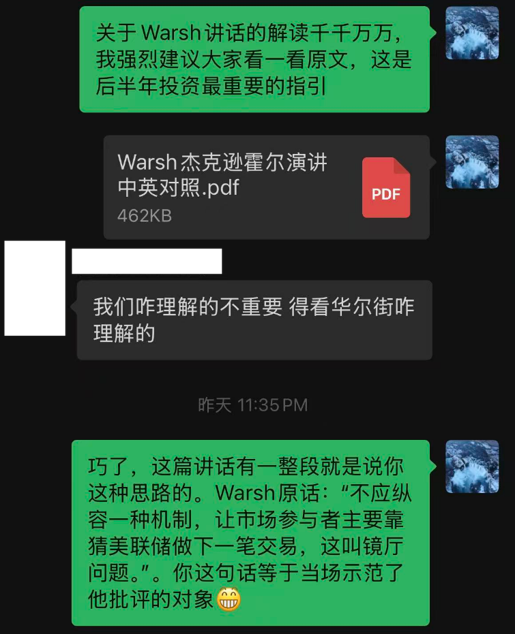
This statement sounds clever; the market is indeed determined by pricing. However, it directly contradicts the point of this speech. Today, we'll start from this statement because the underlying thinking is precisely what Warsh dedicated an entire section to criticize.
First, the conclusion: the most important aspect of this speech is not whether it is "hawkish," but that Warsh announced the rules of the game have changed. Understanding this is far more important than guessing whether there will be a rate hike in September.
First, let's look at the facts: one speech, six versions
What did Warsh actually say? The core message is one sentence:
"My standard is: we must have confidence that potential inflation is clearly and sufficiently moving toward the target. Otherwise, we have work to do."
Note that this is a conditional sentence. The condition comes first, followed by the conclusion; the word "work" was never defined as a rate hike. Yet that evening, Chinese financial media headlines read: "Vow to Combat Inflation," "Warsh Hints Rates May Need to Be Higher," "Bearish Surprise, Gold Plummets."
Even more interesting is the probability of a rate hike in September. That evening, various Chinese media outlets provided numbers: 50%, 56%, 57.4%, 57.5%, 58%, nearly 60%. Six numbers, none of which indicated the timing or criteria. The same speech, the same market, six "facts."
Moreover, most of these interpretations were merely the same press release circulated with different logos. The claim that "major media unanimously interpreted it as hawkish" often just means one article was copied dozens of times.
Next, let's see "how Wall Street understands it": at least three factions, fighting among themselves
Well, let's follow the group member's suggestion and look at Wall Street. I compiled the statements from major investment banks after the speech, and the result is that Wall Street itself is divided into three factions.
Pro-rate hike:
Société Générale is the most hawkish, predicting rate hikes of 25bp in September and December, with another hike in March next year. It is the only major bank I saw that clearly bets on "two hikes this year." Commerce Bank believes there will be at least one hike this year, reasoning that the Fed needs to act to uphold its anti-inflation credibility. Wells Fargo Investment Institute predicts one hike this year and one next year; note that this rhythm is also two hikes, but spread over two years. Nomura indicates that the risk of a rate hike has increased this year.
Against rate hikes:
Goldman Sachs is the most significant opposing party. Hatzius's baseline prediction is that rates will remain unchanged until the end of the year, with cuts pushed to 2027. His original logic: "After two months of noticeably weak employment and inflation data, it's hard to imagine dovish members turning to rate hikes." Goldman also warns that market pricing is already too hawkish.
State Street's chief strategist Arone stated more directly: "The market has already determined a rate hike in September; I'm not sure they will get that result." His basis: last month's non-farm payrolls were negative, retail sales declined, and housing is weak. He believes Warsh is actually betting on both sides, and this speech is also prepared for continued pauses.
Centrist:
Citigroup delayed its rate cut forecast but does not bet on rate hikes. Principal's Shah acknowledges that the risk of a rate hike in September has increased but still expects data to improve. Morgan Stanley predicted before the speech that Warsh would not provide any short-term guidance, and in hindsight, this prediction was accurate.
Putting the statements from each firm into a table makes the differences clear:
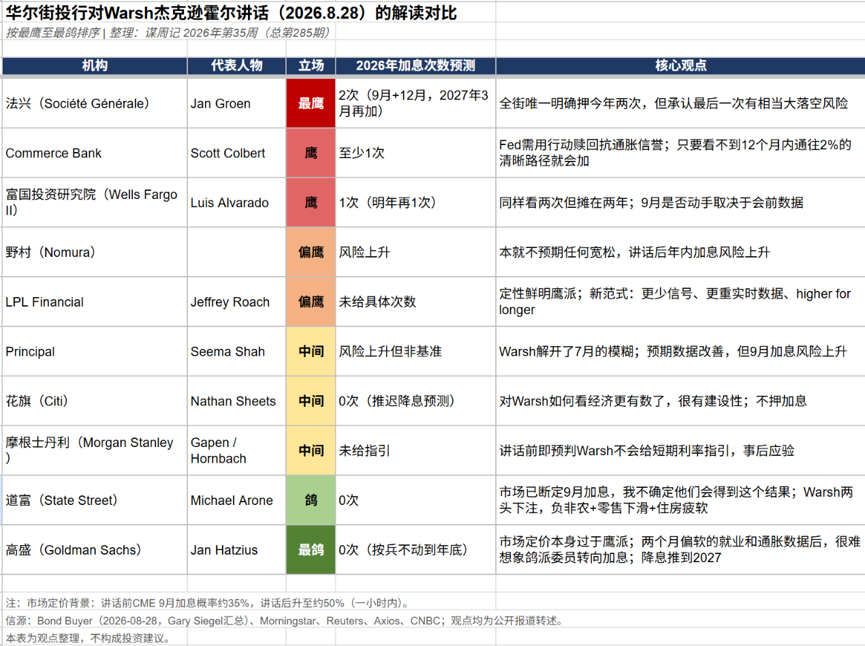
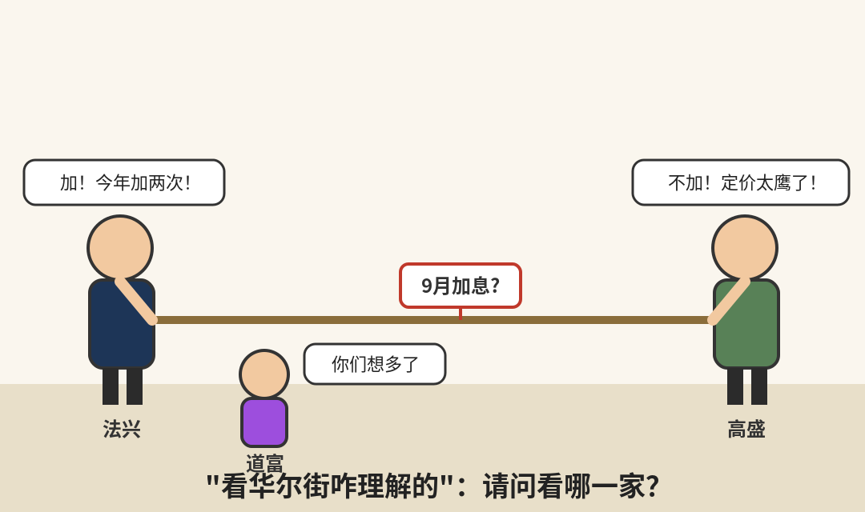
So, "how Wall Street understands it," which one do you plan to look at? Société Générale bets on two hikes, Goldman Sachs bets on zero, and State Street says the market is overthinking it. Wall Street's understanding is not a single answer to copy; it is a market that is currently betting against itself.
The key point: that sentence ignored by all headlines
Now let's discuss the true core of this speech. Warsh's original words:
"We should not indulge a mechanism that primarily has market participants looking to the Fed to decide the next trade."
And the accompanying segment:
"If the market largely relies on the Fed's guidance, and the Fed relies on market prices, then all of us are more likely to overlook new changes, more likely to be caught off guard when conditions reverse, and more likely to make mistakes in policy-making."
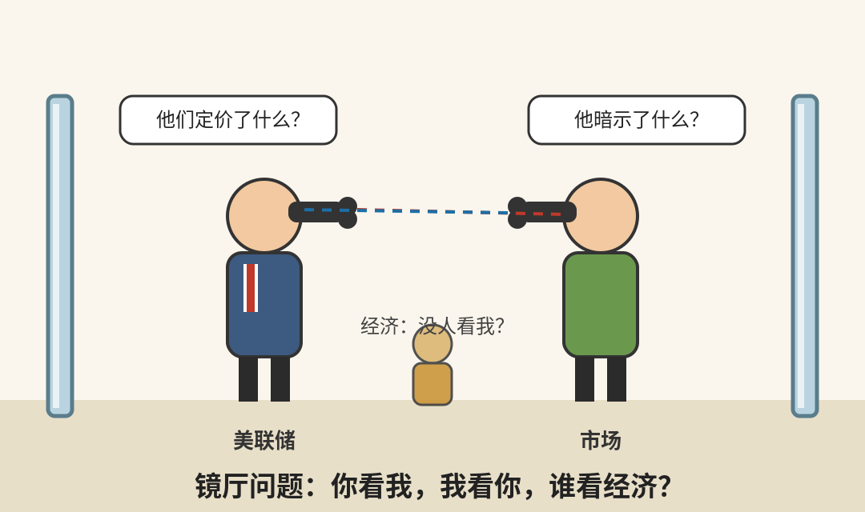
This concept is known in economic literature as the "hall-of-mirrors problem." Two mirrors face each other, reflecting only each other's images, with no one seeing the real room. The market prices based on the Fed's hints, and the Fed makes decisions based on market pricing, ultimately both sides are looking at each other's expressions, and no one is looking at the economy itself.
Warsh cited a very hard case: 2021. At that time, the Fed provided ample forward guidance ("inflation is transitory," "no rate hikes in the short term"), the market believed it, and the Fed became bound by its own commitments, resulting in a response to high inflation that was a full year late. With 65 months of high inflation, he himself said, "the responsibility clearly lies with the central bank."
So what he did this time is essentially a unilateral withdrawal from this game: no forward guidance, no reaction function, no interest rate path, and even the authority of the dot plot is being undermined (the footnote of the speech specifically cited a study stating that market expectations stick to the dot plot, leading to predictable forecast errors). What he wants is a "quieter Fed": you look at the data, we look at the data, and don't guess each other.
What this means for us
The rules have changed, and the way to play must change. Four points:
First, "Fed watching" has depreciated.
For the past decade or so, trading based on subtle changes in officials' wording has been an effective strategy because the Fed indeed conveyed paths through wording. Now the chair has clearly stated that no guidance will be given. In the future, the "signals" interpreted from each speech will have a much larger proportion of noise. The six conflicting rate hike probabilities reported by Chinese media this week are a preview of the new normal.
Second, volatility on data days will increase. If the Fed does not provide guidance, the market can only digest each data point itself, and the divergence and fluctuations in pricing will become more severe. The importance of the August CPI on September 11 has been elevated to an unprecedented height in recent years: both Goldman and Wells Fargo have explicitly tied their judgment on whether to hike in September to it. Friends trading options should directly feel the changes in IV pricing on such event days.
Third, the value of the original text has increased. This is precisely why I suggested everyone read the original text, and it is a formal response to the group member's statement. Before the speech, the pricing for a rate hike in September was 35%; one hour after the speech, it was 50%. Wall Street itself only changed its stance after reading the original text. If you don't read the original text, you'll always be one hour behind and have to rely on sensationalized second-hand accounts. In a market where the official answers are no longer provided, the gap between first-hand and second-hand information will widen.
Fourth, don't directly translate "hawkish" as "continuous rate hikes." This is the biggest misrepresentation in this week's Chinese public discourse. Warsh said, "otherwise we have work to do," while the media interpreted it as "the rate hike cycle has begun." Missing in between are all the counter-evidence: last month's non-farm payrolls showed negative growth, the initial benchmark revision for non-farm was -79,000 (expected +183,000), although three votes at the July FOMC advocated for a rate hike, there was no dissent from the board, and the yield curve that evening was flattening, with the bond market expressing in real terms, "if you really hike, the economy will have problems." My judgment remains unchanged: September is about a 50-50 chance, with a roughly 40% chance of one hike this year and a 25-30% chance of two hikes; it's not a high probability. The dot plot on September 16 will reveal all.
Conclusion
Returning to the group member's statement, "we need to see how Wall Street understands it."
Warsh's speech essentially stated in front of the world: even the Fed does not want you to trade based on guessing others' interpretations anymore. Wall Street's understanding changes every hour, the Chinese media's understanding is based on the same press release, and the official understanding will no longer be provided in advance.
What remains to grasp is just the data and the original text. This is not sentiment; it is the only source of informational advantage under this new rule.
Next week to watch: September 4 non-farm payrolls, September 11 CPI, then September 15-16 FOMC and the new dot plot.
[For next week's outlook and specific holdings details, please visit the website: www.finplusplus.com\]
(The above is a personal opinion summary and does not constitute investment advice.)
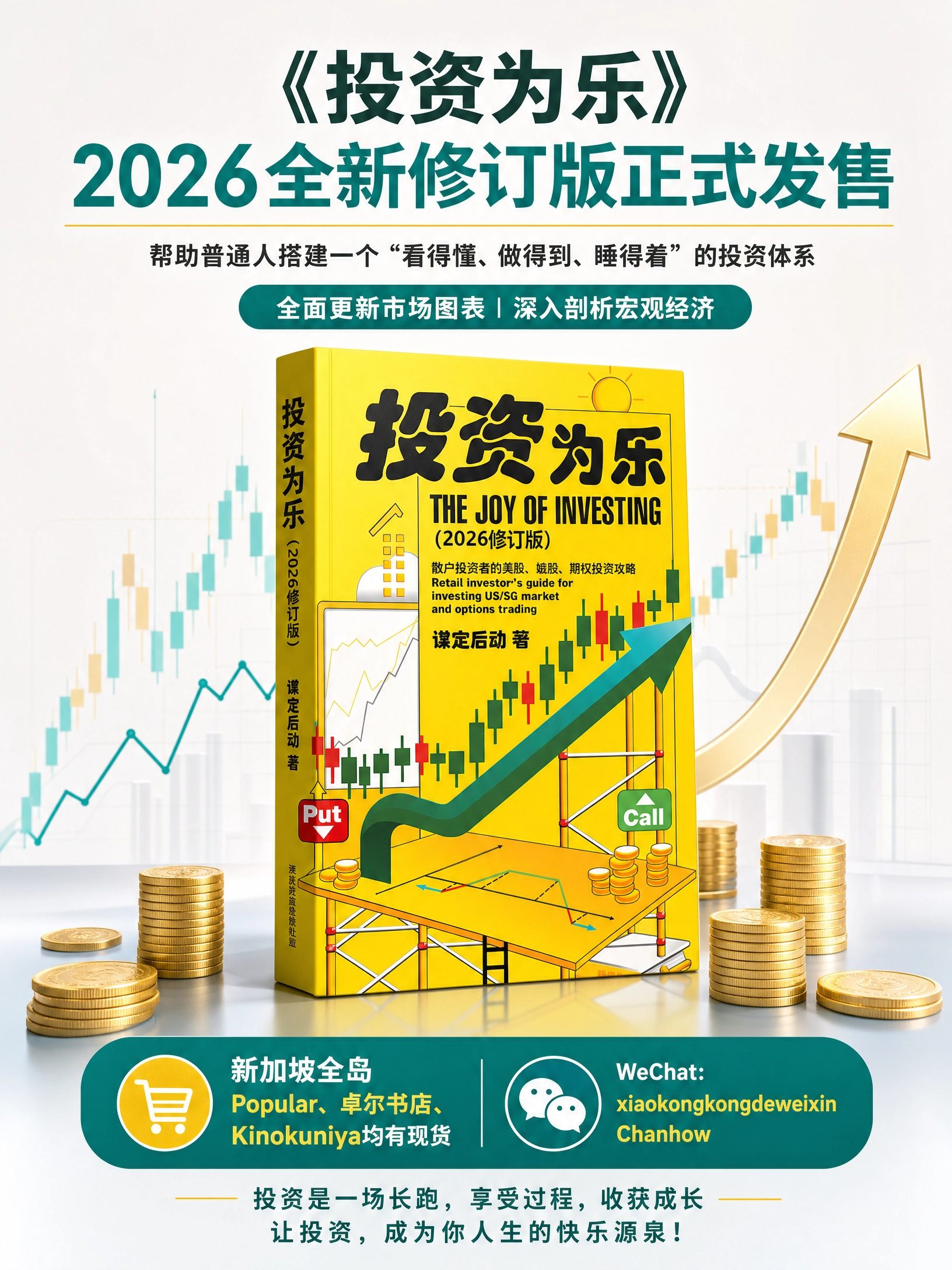
《Investing for Joy 2026 Revised Edition
The 2026 newly revised edition of Investing for Joy is officially on sale! This book does not promise to make you rich overnight; its core mission is to help ordinary people build an investment system that is "understandable, doable, and restful." As a practical guide specifically designed for workplace investors, it is more like a good teacher and friend, accompanying you to turn investing into a long-term, stable survival skill.
【Wechat Community】
Friends who love investing and options strategies, the WeChat group for the MOU community is full. You can add staff as friends, note "MOU Community," and I will add you to the group~

【WhatsApp Community】
【Free Group】 Feel free to discuss investment-related topics without worrying about sensitive word audits.

- 【Muted Group】 MOU will share his pre-market operation ideas and real trades.
- 【Member Investment Group】 Limited to private teaching members, where you can interact with various investment bigwigs and directly @MOU for questions in the group.
- 【Member Chat Group】 Limited to private teaching members, for casual chatting and friendship, with no topic restrictions.
Official website finplusplus.com
- 【MOU Weekly】 and 【MOU Insights】 provide weekly updates and analyses of various industry sectors.
- 【Real Trading Sharing】 is first published on the official website, where you can search for all of MOU's historical follow-ups.
- 【Community】 You can freely initiate discussions, share investment insights, operational strategies, industry insights, etc.
