This week, three things have risen in price simultaneously.
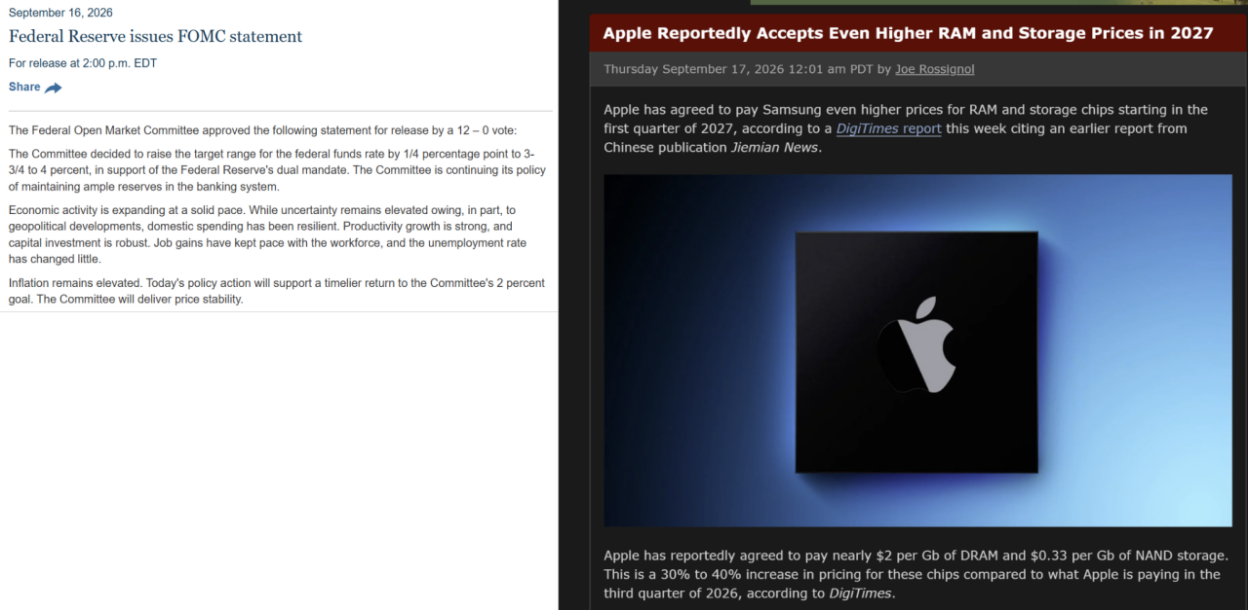
The first is money. On Wednesday, the Federal Reserve raised interest rates by 25 basis points to a range of 3.75% to 4.00%, passing the vote 12 to 0, marking the first rate hike since July 2023.
The second is memory. According to DigiTimes, Apple has agreed to buy DRAM at nearly $2 per GB and NAND at $0.33 per GB starting in the first quarter of next year, which is 30% to 40% more expensive than in the third quarter of this year. This is the buyer with the strongest bargaining power in the world.
The third is storage stocks. SanDisk rose 11% in a single day on Friday, and Micron gained 9.6% over two days.
According to textbooks, when interest rates rise, stocks with high Beta should fall first; however, the opposite has occurred. In this issue, we will examine these three price tags one by one.

First Price Tag: The Price of Money
First, let's set the record straight. Many friends have the impression that "the U.S. stock market rose for two days after the rate hike," which is only half true.
The S&P 500 fell 0.44% on Wednesday, rebounded 1.0% over Thursday and Friday, resulting in a weekly decline of 0.34%. The Dow Jones has fallen for three consecutive weeks. The index has merely returned to where it started; what is truly rising is storage.

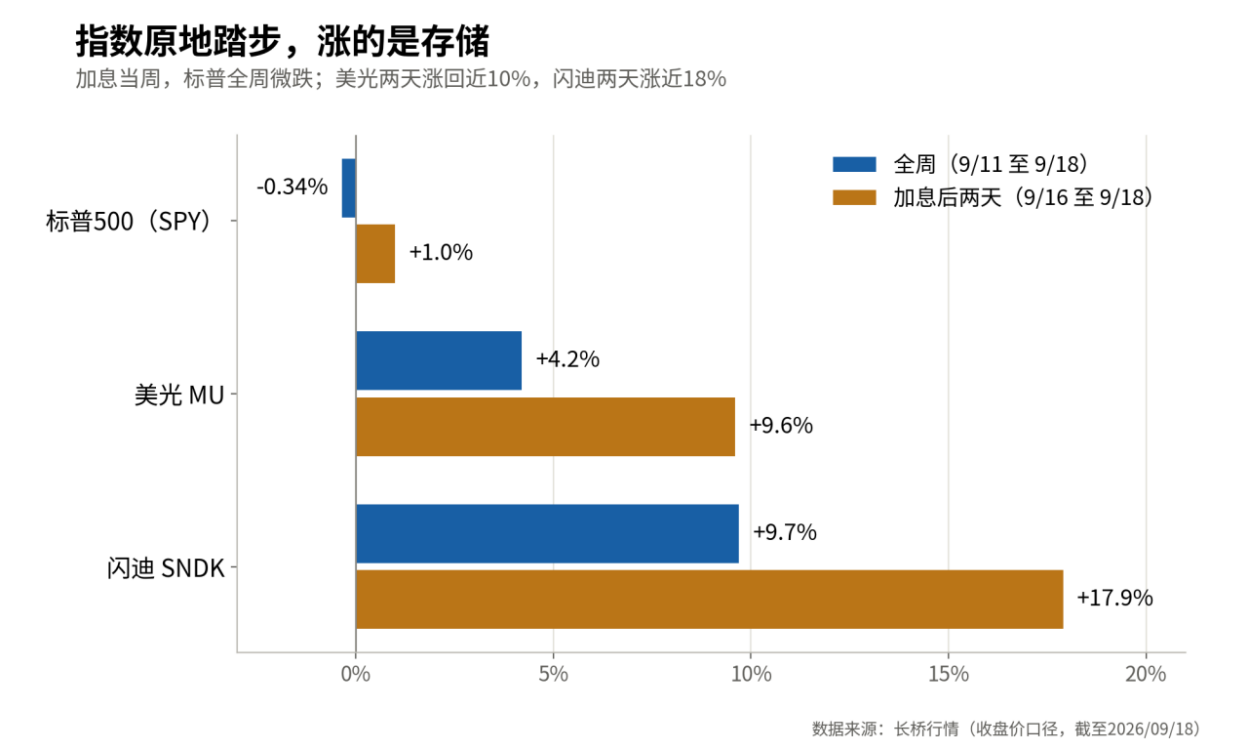
The macro reasons for the rebound over those two days are not complicated: the shoe dropped, oil prices fell about 3% on Thursday, with Brent returning to $103.65, and the 10-year U.S. Treasury yield fell to 4.96%. CICC compared this rate hike to Greenspan's "preemptive rate hikes" in 1997, where the day of the rate hike often marked the peak of interest rates and the trough of the stock market.
The problem is that this is just one interpretation of the stock market.
The Fed's statement has only three paragraphs, with the last sentence stating: "The Committee will achieve price stability." In the dot plot, 16 out of 18 officials believe there will be at least one more rate hike this year, and the median for 2027 remains the same as this year at 4.1%, indicating no cuts next year. The core PCE is projected at 3.4% this year, and inflation is not expected to return to 2% until 2029.
Wall Street itself lacks consensus. Goldman Sachs reversed its position twice in four days, now betting on another hike in October, reasoning that "continuous action is more natural than a one-time hike followed by a pause." Morgan Stanley and JPMorgan are looking at December. Citigroup believes there will be no more hikes this year, with cuts starting in June next year.
The bond market provided its answer on Friday: the 2-year U.S. Treasury yield hit 4.744%, a multi-year high, and CME shows a 53.1% probability of another rate hike in October.
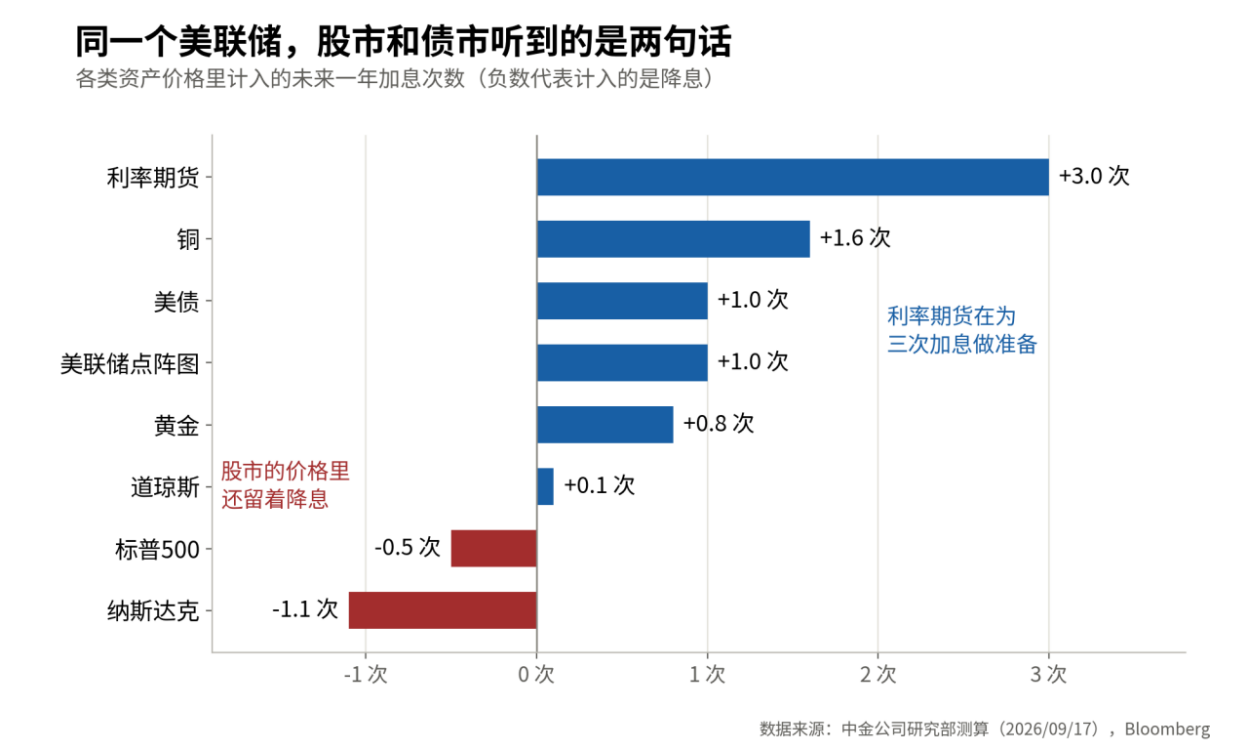
CICC calculated that the prices in interest rate futures account for three rate hikes over the next year, while the S&P accounts for negative 0.5 hikes and the Nasdaq for negative 1.1 hikes. The same Federal Reserve is sending two different messages to the stock and bond markets. One side must be wrong.

Second Price Tag: The Price of Memory
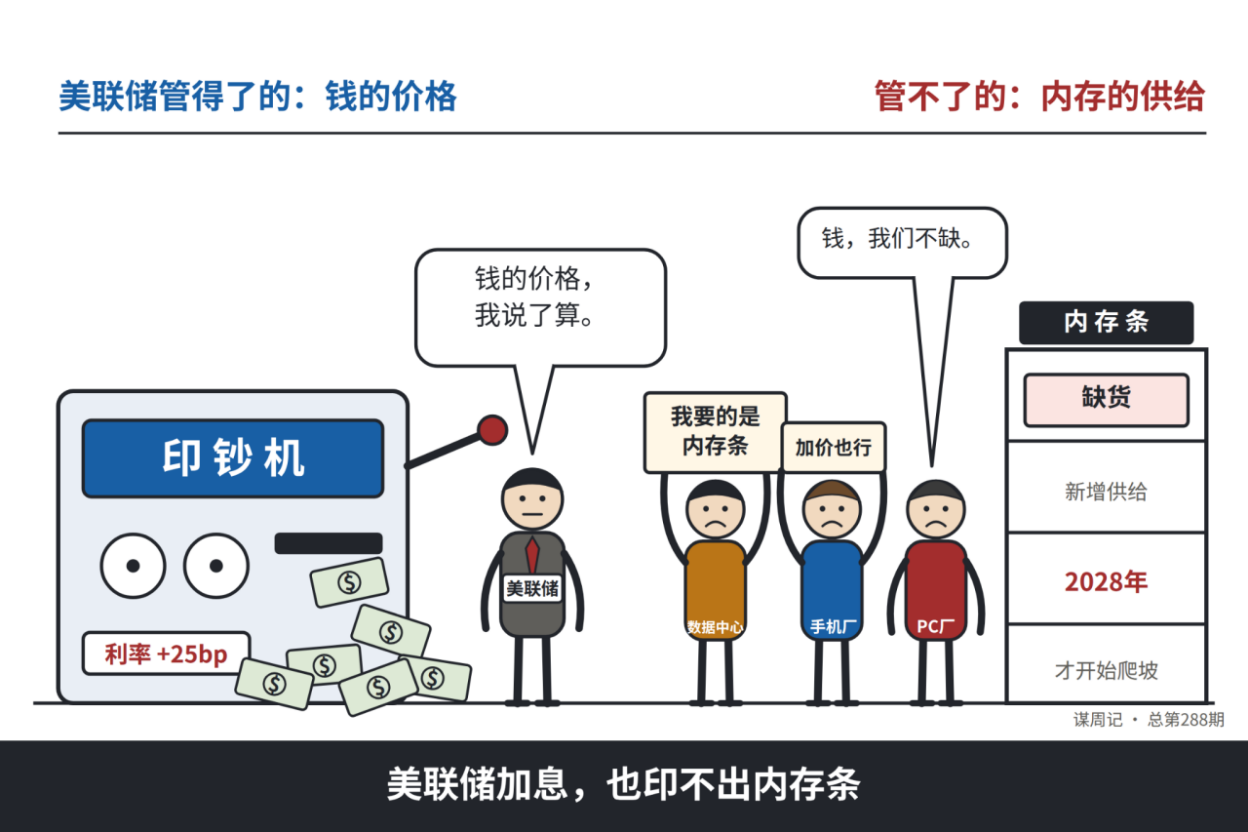
Why is storage not afraid of rate hikes? Because the only thing rate hikes can do is make money more expensive and suppress demand. They cannot reduce supply.
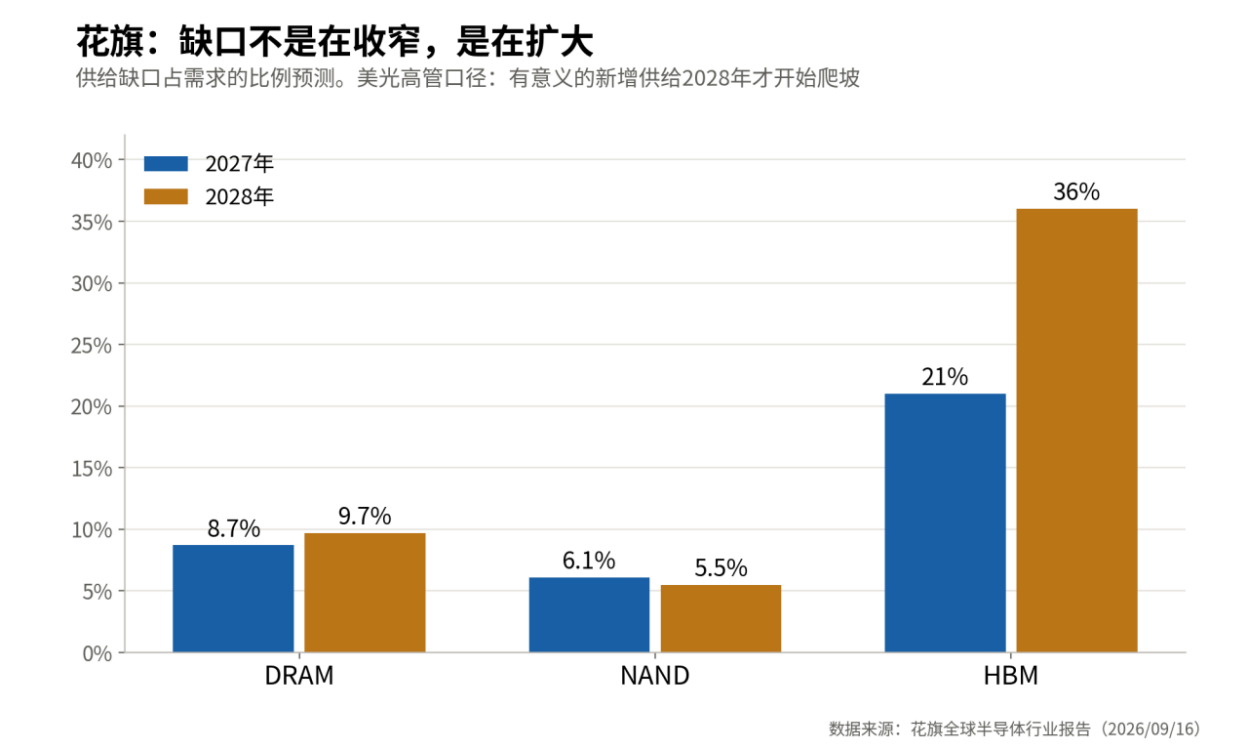
The contradiction in this round of storage is not in demand but in supply. Micron executive Sadana said this week that meaningful new supply will not begin to ramp up until 2028, and currently, there is no sight of a supply-demand balance point. Intel CEO Pat Gelsinger stated that shortages "will get worse," with many projects delayed due to the inability to secure memory. Citigroup's report on Wednesday projected shortages to last until 2031, with customers extending long-term contracts from three years to five years.

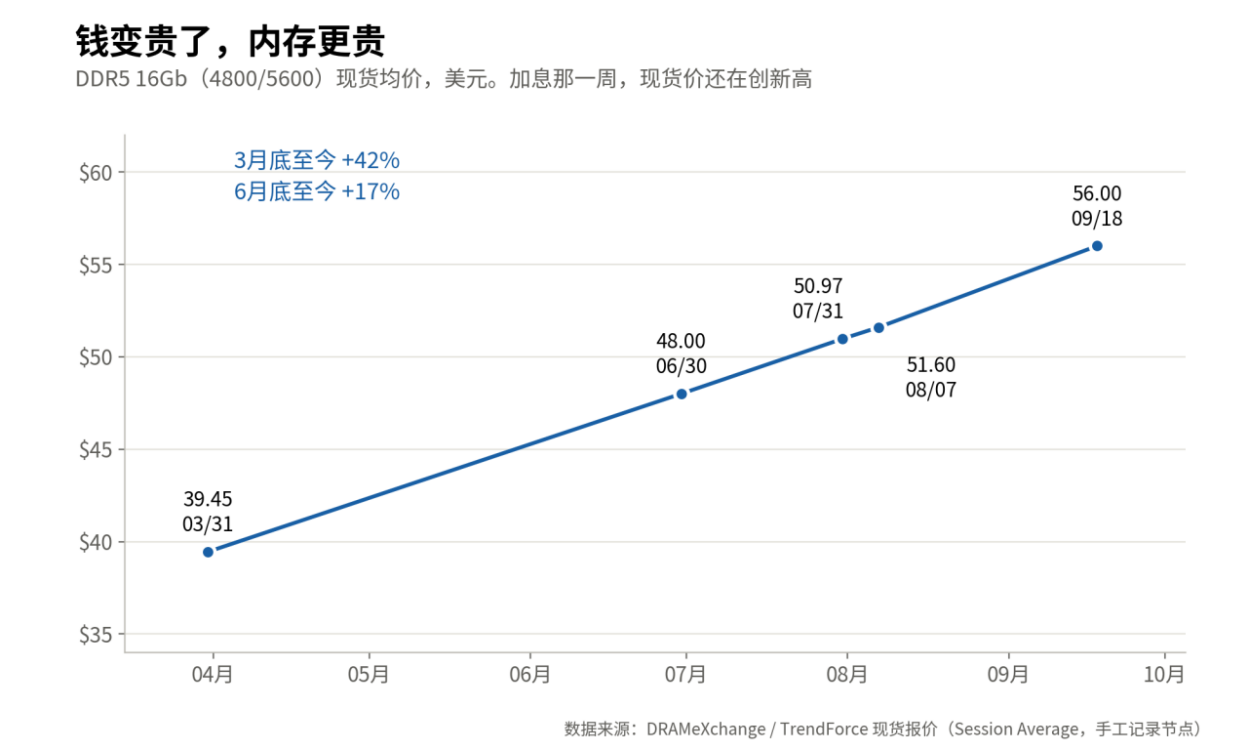
Prices are the most honest indicators. I have been keeping track of the spot price of DDR5: $39.45 at the end of March, $48 at the end of June, and $56 on the Friday of the rate hike week. It has risen 42% in less than six months, reaching new highs during the rate hike week.

At this point, it's worth looking back at a piece of history.
In the 1970s, Burns and Volcker successively held the position of Fed Chair, and interest rates could be raised continuously, reaching double digits. However, there was one thing they could not print: oil. The winners of inflation during that decade were those who held oil. By 1980, energy stocks accounted for nearly 28% of the S&P 500's weight.
Today's scenario is almost a mirror image. This rate hike was itself forced by oil prices, with Brent still above $100. The "oil" of the AI era is memory. Interestingly, the rising prices of memory have already become part of inflation: Apple raised the prices of its entire Mac and iPad line by $100 to $300 in June, citing memory as the reason, with Cook's exact words being "a once-in-a-century flood." One component of the inflation that the Federal Reserve is combating is the profits of storage companies.
In an inflationary era, companies that can raise prices are anti-inflation assets.
However, this piece of history has a second half that we must also consider: the 28% weight of energy stocks has now shrunk to about 3%. The winners created by shortages are time-limited, and the duration depends on when supply will come. This leads us to the third price tag.
Third Price Tag: The Price of Storage Stocks
A solid logic does not mean that prices can be chased casually. Behind this price tag, there are five things worth noting.
The big bullish candle on Friday had no new news. SanDisk's $14 billion buyback was announced during the August earnings report, and 24/7 Wall St's exact words were "no identifiable catalyst could be found." Friday was also a triple witching day. A single-day surge on options expiration day cannot be taken as a fundamental signal to chase.
What storage fears is not the interest rate, but the customers' wallets. Micron's expected P/E ratio for next year is only 5.8 times, and such a valuation is not afraid of discount rates. What needs to be monitored is another chain: rate hikes, AI financing becoming expensive, capital expenditures slowing down, and storage orders. In FactSet's forward data, the free cash flow forecasts for Google, Amazon, and Meta are all negative, with only Microsoft being positive. Apollo's chief economist Slok reminded this week that the 5-year CDS for the mega cloud basket (Amazon, Google, Microsoft, Oracle) has risen to over 100 basis points, while major banks only have 40, with Oracle contributing the most. In Bank of America's September fund manager survey, 42% of respondents listed AI infrastructure spending as the most likely source of a systemic credit event, while 79% believe no company will cut spending this year. These two numbers together represent the risk itself.

A P/E ratio of 5.8 is a vote of distrust from the market. Cyclical stocks at the peak of earnings always appear to be the cheapest. Micron's guidance for this quarter is revenue of $50 billion, with the quarter-over-quarter growth rate dropping from 74% in the previous quarter to 21%. The expected quarterly increase in DRAM contract prices has also dropped to between 13% and 18%. Prices have not stopped rising, but the pace is slowing.
The Micron earnings report on September 30 will be the referee. The implied volatility for the earnings report is about 11%. Among 27 analysts, 26 have buy ratings, but target prices range from Goldman Sachs' $1100 (neutral) to $2000 from four firms, a difference of nearly 100%.
There are two clouds on the horizon. According to Reuters, ChangXin is preparing to enter the NAND market, with the news coinciding with SanDisk's big rise. The consumer end is being squeezed out by price increases, with smartphone shipments expected to decline by 13% this year.
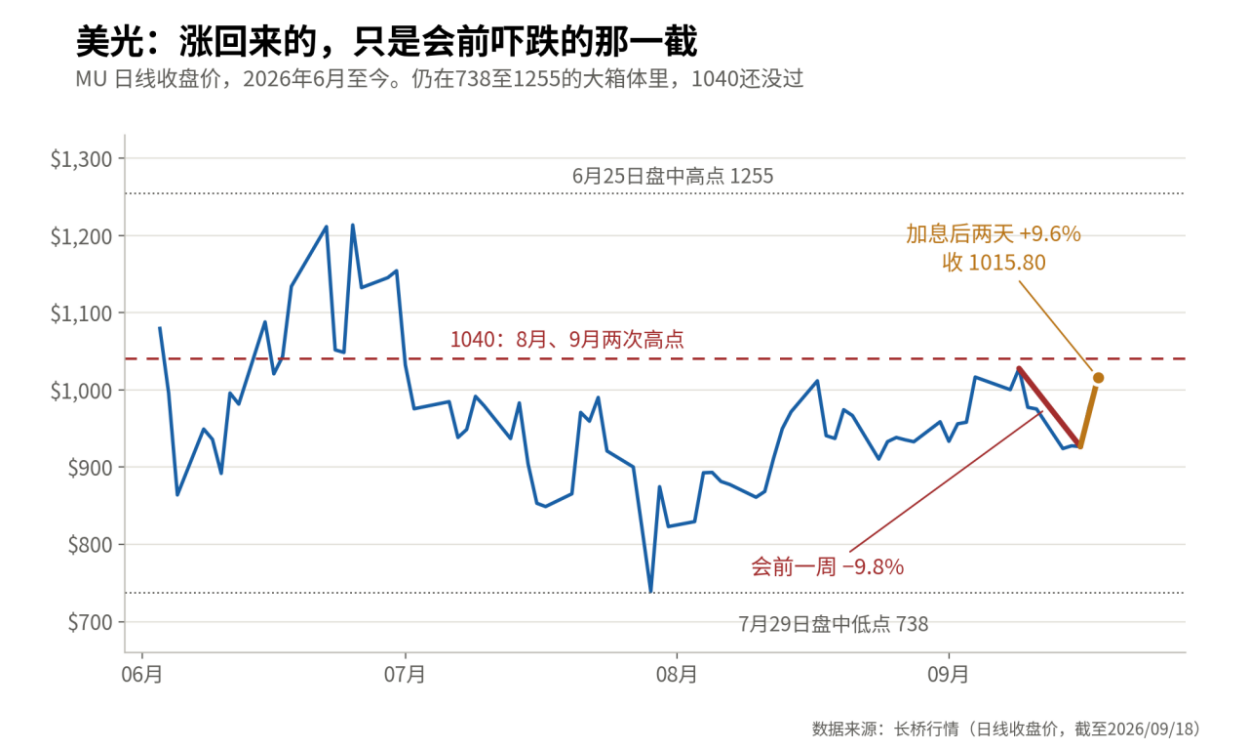
Now, looking at Micron's position. In the week before the meeting, it fell from 1027.77 to 926.55, a drop of 9.8%; it then rose back to 1015.80 in the two days after the rate hike. What has risen back is only the portion that was scared down before the meeting. It has touched around 1040 twice in August and September but has not broken through, and it is still 19% away from the June high of 1255. It remains within a large range between 738 and 1255, without choosing a direction.
The Insurance from Last Week Needs to Be Accounted For
In the last issue, I wrote: Sell Put all closed, the underlying stock and Call unchanged, all added Sell Call. As a result, storage rose nearly 10% over two days this week. Some friends may ask: Did I lose?
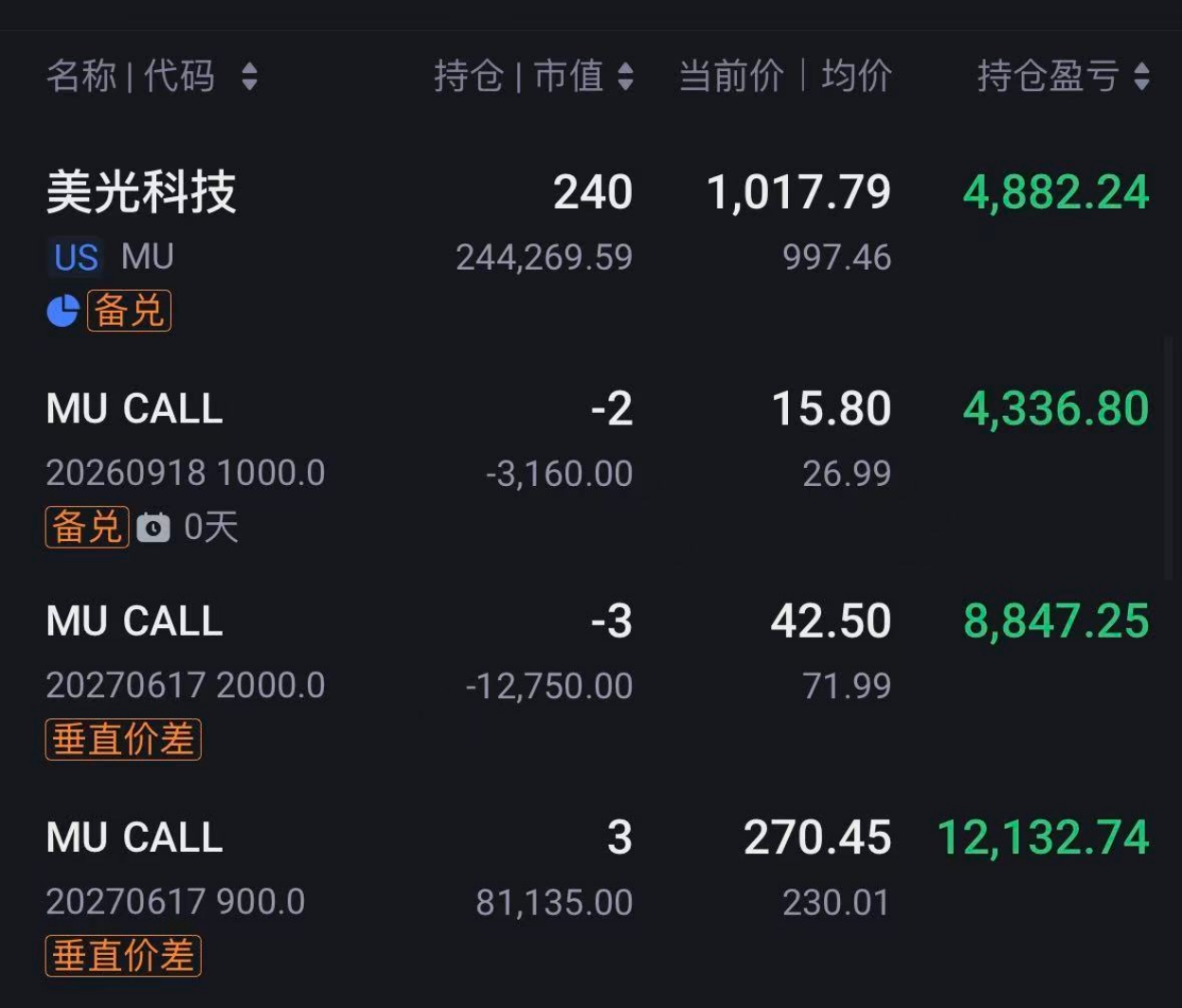

Above is my actual position in Micron; the specific strategy will be detailed in our member group.
Final Thoughts
The Federal Reserve can determine the price of money but cannot determine the price of scarcity. Interest rates are set by central banks, while the timeline for shortages is determined by foundries.
Next Week's Outlook
Next week in the U.S. stock market will be a week in the eye of the storm.
Last week's cards have been flipped: the rate hike has landed, the index remains stagnant, storage has recovered the losses incurred before the meeting, and the bond market has not celebrated along.
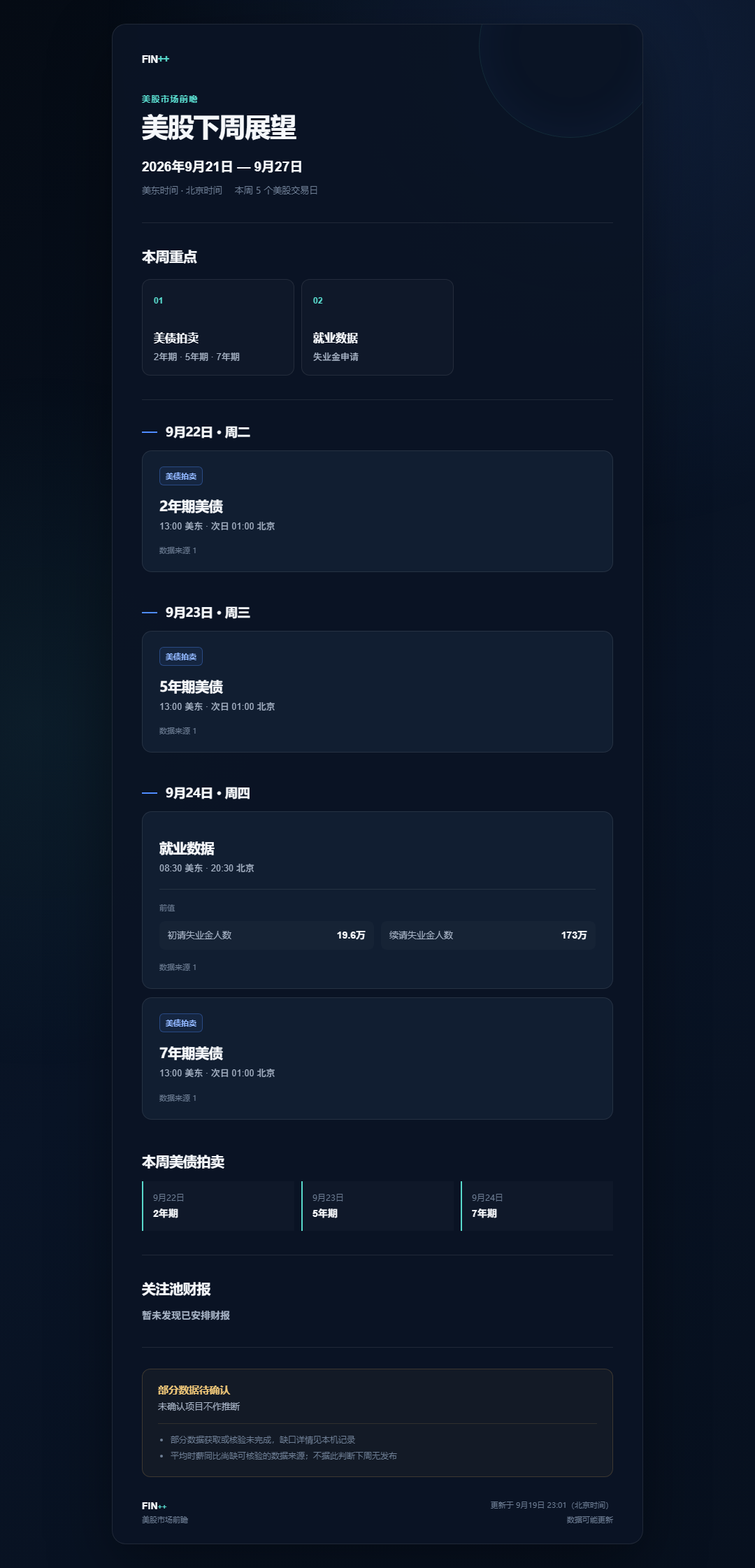
Next week's card table is quite empty. On Wednesday, there is the PMI preliminary value, on Thursday initial jobless claims and new home sales, and on Friday durable goods orders and Michigan consumer confidence, with only Costco's earnings report on Thursday after the market worth a glance. What we really need to listen to is the speeches of Federal Reserve officials after the quiet period ends; whether the probability of a rate hike in October can stabilize above 50% will depend on what they say.
The following week will be the main event: on September 30, PCE and GDP final values, Micron's earnings report, and quarter-end liquidity will collide on the same day.
The stock market is waiting for Micron, and the bond market is waiting for the Federal Reserve.
[For specific operations and position details, please visit the website: www.finplusplus.com\]
This article represents personal opinions and probability assessments and does not constitute investment advice. Data sources: Market data from ChangQiao (closing price basis, as of September 18); FOMC statements and economic forecast summaries from the Federal Reserve's official website; investment bank opinions from TradingKey, Invezz, Benzinga, and reports from CICC and Citigroup; Apple procurement prices from reports cited by DigiTimes; DDR5 spot prices from DRAMeXchange; energy stock weights from CME Group; mega cloud CDS from Apollo's "Daily Spark"; fund manager survey from Bank of America.
Investing: A Long-Term Skill to Master
The newly revised edition of "Investing for Joy" 2026 is now officially on sale.
Investing is not just about rises and falls or profits and losses; it is more about how to establish a method that suits you amidst a busy life.
This practical guide, designed for workplace investors, does not promise overnight wealth but accompanies you in building an investment system that is understandable, actionable, and sleep-inducing, making investing a skill that can be refined over the long term.

Find Friends to Discuss Investments Together
WeChat · MOU Community
If you want to exchange investment insights and discuss options strategies, feel free to join the MOU Community. The existing WeChat group is full; you can add the staff's WeChat and note "MOU Community," and they will arrange for you to join a new group.

WhatsApp · Free Investment Discussion Group
Discuss the market, strategies, and thoughts and confusions along the investment journey. Friends who love investing are welcome to join for free exchange and learning together.

For More In-Depth Communication, Welcome to Learn About VIP Services
If you wish to continuously follow MOU Teacher's market observations, operational ideas, and real-time records, and want to engage deeply with more investment peers, you can learn about FinPlusPlus VIP services.
Member Community
• Operation Sharing Group (Muted Group): Concentrated viewing of MOU Teacher's pre-market ideas and real-time operations, reducing information interference.
• Member Investment Group (Private Coaching Members Only): Exchange with investment peers and directly @MOU Teacher for questions.
• Member Chat Group (Private Coaching Members Only): Chat about life and make friends beyond investing.
Website Content and Community
• MOU Insights · MOU Weekly: Continuously follow market dynamics and industry sector analysis.
• Real-time Sharing: First published on the official website, supporting the retrieval of historical operation records for easy review and replay.
• Investment Community: Share investment insights, operational strategies, and industry observations, and initiate discussions on topics of interest.
Learn About VIP Services →
Website Registration:
finplusplus.com
The exchange and real-time sharing are for learning reference and do not constitute investment advice. Make independent judgments and act within your means.
