In 1984, DRAM prices plummeted by 70% within a year, leading Intel to suffer massive losses and decisively exit the memory business it had invented, leaving behind the famous phrase from Grove: "crossing the valley of death." Meanwhile, on the other side of the Pacific, a South Korean company that had only been in the industry for a few years doubled down and expanded production against the tide during this dark moment of industry losses — it was Samsung. The rest of the story is well-known: Japanese manufacturers were driven out, and Samsung ascended to the throne of memory, holding it for forty years.
Why start with this old story? Because the recent sharp decline in memory stocks is being discussed as the "sequel" to this story: will China's Changxin Memory Technologies (CXMT) aggressively expand production and rapidly go public, making it the next Samsung? Will it crush this round of the memory super cycle?
The panic is real, and so are the questions. But as investors, we cannot just listen to the narrative; we must also look at the input parameters. In this issue, we will break down this round of decline point by point: which are the real fundamental shocks, which are emotional amplifiers, and why I choose to continue holding and even consider increasing my position at this point.
I. Market Review: Three Steps Down in a Week
First, let's look at the market. MU's performance this week was like a roller coaster: on July 14, boosted by analysts raising target prices and the $250 billion U.S. factory news, it surged about 5% to $983; on July 15, the simultaneous fermentation of CXMT's subscription and rumors of tightening HBM export controls to China led to a single-day drop of 7%; on July 16, it fell another 5.6%, breaking through the $898 support, hitting a low of around $853; on Friday (July 17), it rebounded 3.3%, closing near $880.
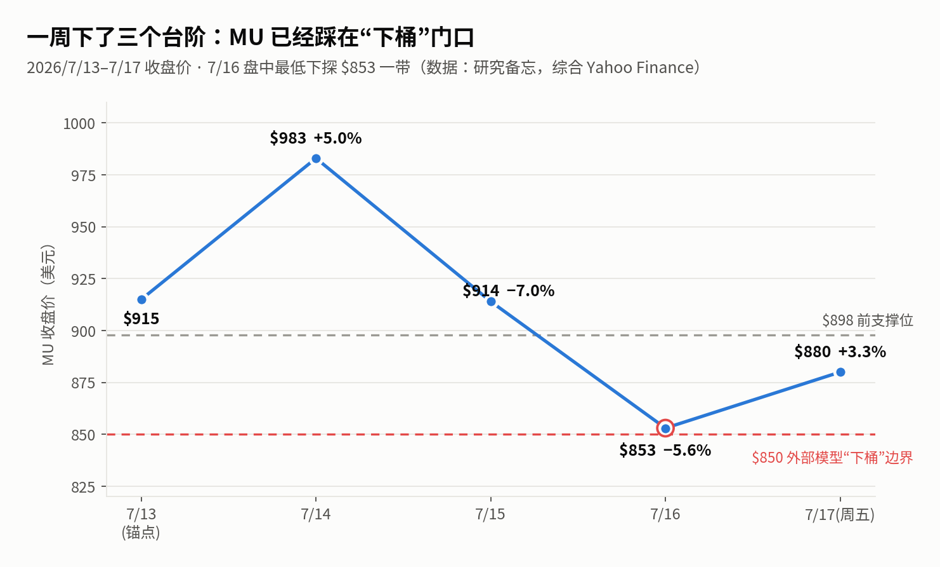
A noteworthy detail is that, starting from the $915 anchored in the external forecasting model's last report, the stock price has actually reached the boundary of "below $850." This means that this week's decline has already priced in a considerable amount of bad news. There were already signs of a large number of short covering during Friday's trading, but the rebound could not be sustained — shorts began to retreat, while longs have not yet dared to enter, which is a typical divergence period in the market.
II. Analyzing the First Negative Factor: CXMT — Urgent Financing, Slow Capacity
The primary driver of this decline is CXMT's IPO: it opened for subscription on July 16 and will be listed on the STAR Market on July 27, raising approximately 66.6 billion yuan (about $9.8 billion), nearly double the original plan. The use of funds is clearly stated: 13 billion for DRAM technology upgrades, 7.5 billion for production line enhancements, and 9 billion for R&D.
The pace is frighteningly fast, right? But please note a key distinction: financing is an immediate matter, while the capacity impact is a slow variable for 2027.
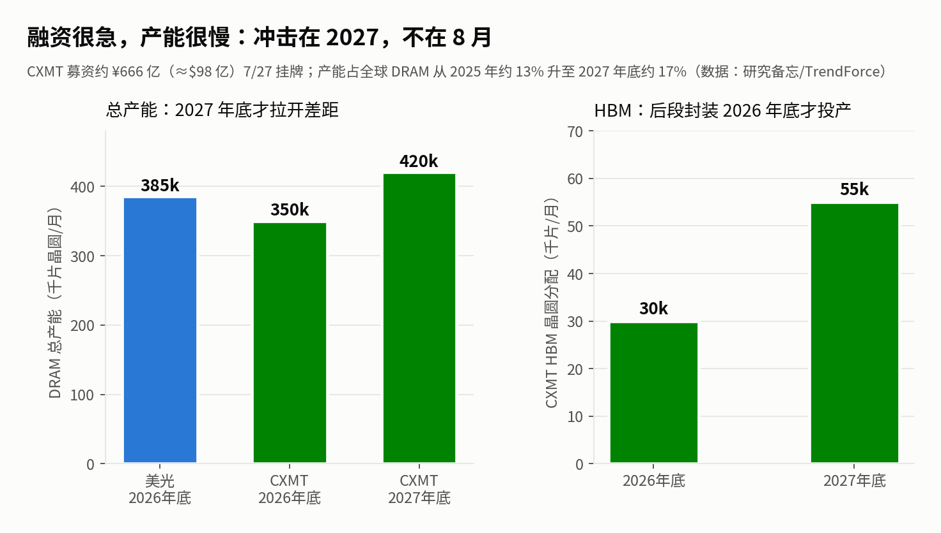
Data is often more real than news headlines. According to the current expansion timetable: by the end of 2026, CXMT's total capacity will be about 350,000 wafers per month, slightly lower than Micron's 385,000 wafers; it will only reach about 420,000 wafers by the end of 2027, accounting for about 17% of global DRAM capacity (about 13% in 2025). HBM will be even later: the back-end packaging will only start production by the end of 2026, and the HBM wafer allocation will only be 55,000 wafers per month by the end of 2027.
Logical Point: In the foreseeable future months, there will be no substantial supply shock from CXMT. Its impact path is the market pricing in "future excess" in advance — and this part has already been largely reflected in the decline from $915 to $850. Panic has priced the distant concerns of 2027 as immediate worries for next month.
III. Analyzing the Second Negative Factor: Export Controls — Not a New Ban
Next, let's look at the second negative factor: the U.S. plans to tighten HBM exports to China. It sounds alarming, directly hitting Micron's most profitable product line. However, a look at the BIS documents reveals that HBM export controls to China have long existed; the current rules already regulate HBM with a bandwidth density exceeding 2 GB/s/mm². The "tightening" mentioned in the July news is merely a discussion of adding to the existing framework, with no new regulations implemented or timelines established.
Moreover, in 2023, China has already blocked Micron from key information infrastructure procurement on the grounds of security review — Micron's direct exposure to China was already limited. How much marginal impact can there be from adding another lock to a door that was already mostly closed? This is a suspended policy risk, affecting sentiment rather than profitability.
IV. What the Market Wrongly Penalized: HBM is the Profit Engine
After breaking down the first two points, the real pricing deviation in this round of decline becomes clear: the market has mistakenly equated the medium-term excess risk of commodity DRAM with the breach of HBM's moat.
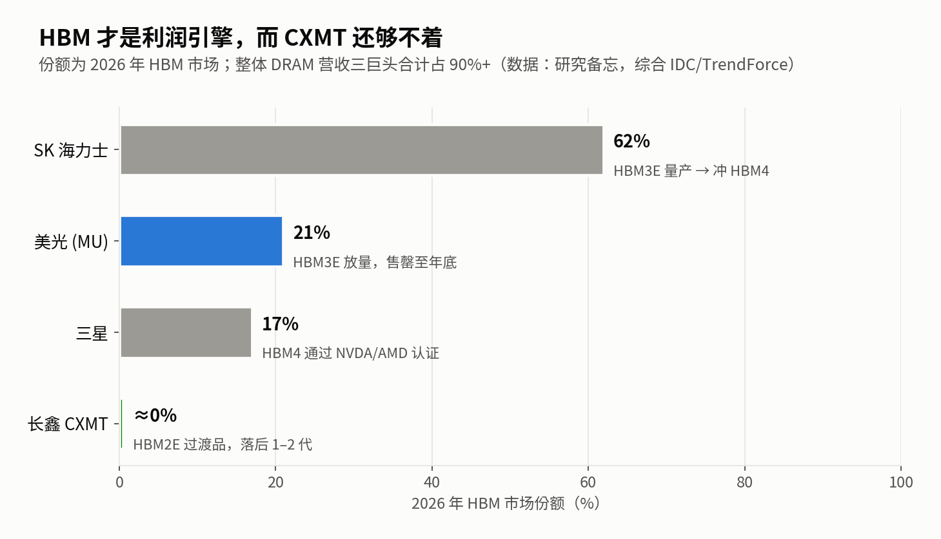
Looking at this chart makes it clear. In the HBM market of 2026: SK Hynix holds about 62%, Micron about 21% (having surpassed Samsung), Samsung about 17%, and CXMT is approximately zero. CXMT is currently mass-producing transitional products like HBM2E, while the supply of HBM3's 8-layer stacking is still unstable, and the 12-layer is even more challenging, with the goal for HBM3E set for 2027 — lagging by one to two product generations.
Where's the difficulty? It's not in the DRAM chips but in the HBM back-end stacking and packaging: thermal stress, chip cracking, warping, bonding defects, and yield ramp-up — this is precisely the segment with the highest barriers in the entire memory industry, which cannot be solved by simply throwing money at it in the short term. The overall DRAM market has a combined revenue share of over 90% for the three giants; although CXMT's capacity share is increasing, its products are concentrated in low-end DDR4/DDR5 and mobile memory, with its revenue share far smaller than its capacity share.
In summary: CXMT will not reach HBM before 2027 and cannot touch Micron's core profit engine; the real pressure it exerts is on the lower-value conventional DRAM. Panic based on Samsung's script forgets that Samsung faced contemporaneous competition, while today's CXMT is separated by two generations of technology and a packaging chasm.
V. Divergence is the Soil of Opportunity
On the fundamental side? The bullish logic remains intact: KeyBanc maintains a target price of $1,750 after researching the Asian supply chain and has raised the price trajectory — Q3 DRAM contract prices are expected to rise by 15% to 20%, with another 15% increase in Q4, and HBM prices expected to double by 2027; Citi reiterates a buy rating with a target of $1,400. Goldman Sachs has raised the projected DRAM supply-demand gap for 2026 from 3.3% to 4.9%, the tightest in 15 years. SK Hynix's capacity for 2026 is essentially sold out, and Micron's HBM has already been sold through the end of the year. The take-or-pay long-term contracts lock in profit bottoms, and the $250 billion U.S. factory takes on additional significance for localization hedging under the new narrative of "Chinese competition."
Of course, the divergence is real: TrendForce has lowered its Q3 conventional DRAM contract price increase expectation to 13% to 18% — remember, the market previously expected 60% to 90%; smartphone demand is expected to decline by 13% for the year, the largest annual drop in history.
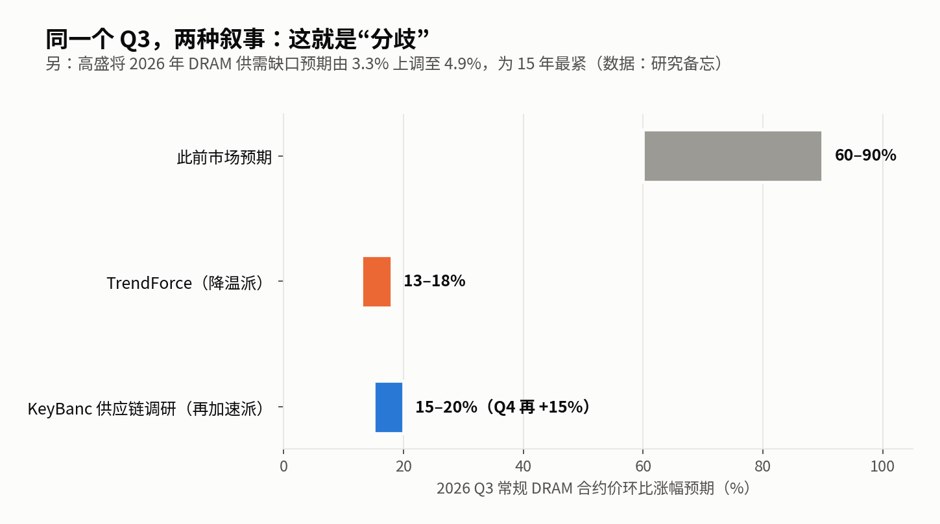
On one side is KeyBanc's "price increase accelerating," and on the other is TrendForce's "price increase cooling," with sellers arguing in a chaotic manner. Many friends panic upon seeing the divergence, but I want to say the opposite — investment opportunities arise precisely when there are divergences and panic. When everyone agrees, there are no bargains left in the price; only when arguments arise does the market produce incorrect prices. No divergence means no discount, and no panic means no wrongful punishment.
VI. Practical Strategy: Do Not Reduce Positions, Gradually Recovering
A group member asked: Should I invest in crypto or memory now? I would unhesitatingly choose memory. Look at Korea: KOSPI has fallen nearly 30% from its peak, and Samsung and SK Hynix have experienced double-digit drops in a single day, even triggering circuit breakers — the deleveraging in the Korean market is nearly complete. The most crowded chips along the memory chain have already been forcibly washed out; the impact of the current decline is diminishing.
My operations and detailed views have already been shared in the large group; here’s the framework:
Position Management: Continue to hold, and I may choose to increase my position. At this point, even if I do not increase my position, I will not reduce it.
Rhythm Prediction: The possibility of continued bottoming is very high. Panic will not end in a day; bottoms are always ground out, not smashed out.
Recovery Methods: Utilize high volatility to repeatedly operate CC (covered calls). During the bottoming period, direction may not yield profits, but time value does — premiums are real cash flow, allowing positions to pay themselves while waiting for the right side.
To be honest, this approach is not glamorous, but in the face of over 100% realized volatility and a beta of 2.14, surviving is more important than betting on the right direction.
Investment opportunities arise precisely when there are divergences and panic.
Forty years ago, Intel exited memory in panic, while Samsung bought capacity in panic — the same crisis, two choices, two destinies. In times of panic, all that is seen are bad news; but what determines your returns is never the quantity of news, but whether you look at the narrative or the data in panic.
Lightning always strikes in the storm, and divergence and panic are that storm.
Outlook for Next Week
After the market closes on July 22, Google's earnings report will be the next key observation point — the focus is not on advertising revenue but on capital expenditure: if AI capex continues to rise, the narrative of memory shortages will remain valid, which will also be a litmus test for whether this round of sector de-rating can stop. In the same week, on July 27, CXMT will officially list; pay attention to its pricing and trends for spillover effects on A-share semiconductor sentiment. Additionally, continue to monitor SOX at the key level around 11,950, as well as the final landing of Q3 DRAM contract prices — the cooling faction and the acceleration faction will eventually have to recognize their mistakes.
[For specific operations and position details, please visit the website: www.finplusplus.com\]
This article represents personal views and probability assessments and does not constitute investment advice. Data sources: Research Memo (2026/07/13–17), integrating TrendForce, SemiAnalysis, BIS/Federal Register, IDC, Yahoo Finance, etc.
