In 1882, Edison lit up the first commercial power station on Pearl Street in Manhattan. The first to profit were not the consumers of electricity, but those who manufactured generators and drew copper wire. However, electricity truly changed the world not through light bulbs, but through electric motors: when factories replaced steam engines with electric motors, productivity did not increase for the first twenty years, until engineers realized that motors could be miniaturized and installed in every machine, leading to the birth of the assembly line, which dramatically boosted productivity in the 1920s. From Pearl Street to the assembly line, electricity took forty years, divided into three phases: first, those generating electricity made money, then the transmission networks profited, and finally, those who integrated electricity into every machine earned the largest share.
Why tell this old story? Because this issue will lay out my current holdings: why I am fully invested in AI, how I structure my investments, and how big money is positioning itself in this week's 13F filings. The core judgment can be summarized in one sentence: AI is completing in five years the journey that electricity took forty years.
1. AI is Electricity, Not Telegraph
New technologies fall into two categories: the telegraph changed one industry, while electricity transformed the cost structure of all industries. AI belongs to the latter category: it alters the price of "intelligence" as a production factor. Tasks that previously required hiring people for analysis, coding, customer service, and driving are now priced per token, with costs decreasing exponentially.
In comparison to the three phases of electricity: computing hardware is generation, models and software are the grid, and robotics and autonomous driving are the integration of electric motors into factories. Today's position is roughly at the stage where power stations are most enthusiastic, the grid is just being laid out, and the assembly line has not yet formed. Major capital expenditures from giants are still increasing, and upstream orders are backed by real money from downstream investments. The next 2 to 5 years will be the main growth phase; the discussion is not whether to get on board, but which carriage to sit in.
2. One Main Line, Four Layers of Structure
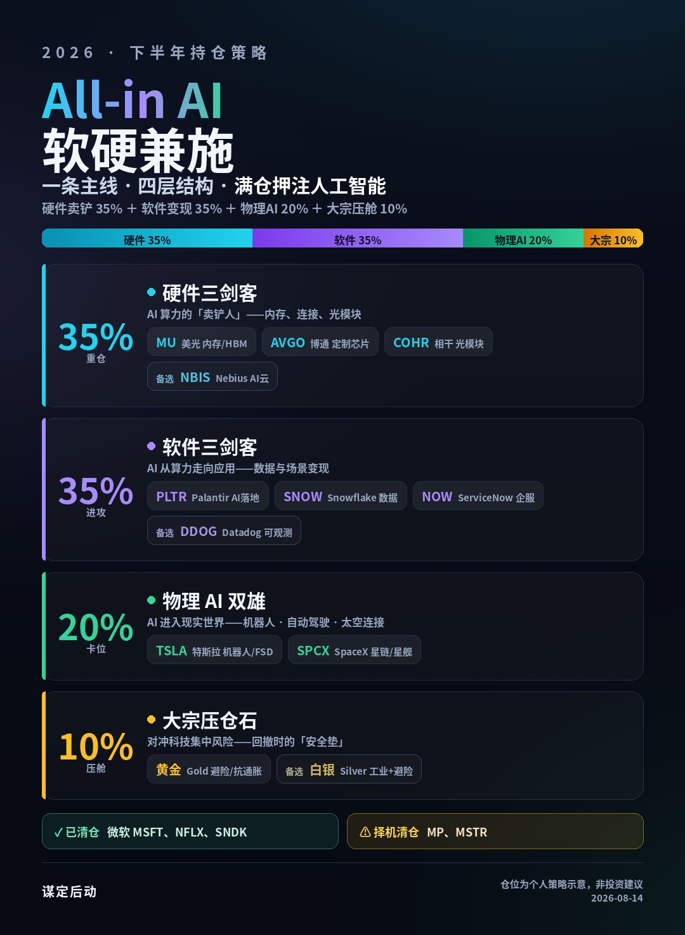
The answer is to fully invest in one main line, but not in a single point: four layers laid out, combining both hardware and software.
Hardware layer 35%, shovel sellers. Micron MU (memory/HBM), Broadcom AVGO (custom chips), Coherent COHR (optical modules), with Nebius (AI cloud) as an alternative. As long as the issue of computing power shortage is not resolved, shovels will continue to sell.
Software layer 35%, rent collectors. Palantir (AI implementation), Snowflake (data), ServiceNow (enterprise services), with Datadog as an alternative. Computing power ultimately leads to applications, similar to how the grid earns slowly but lasts the longest.
Physical AI layer 20%, positioning. Tesla (robotics/FSD) and SpaceX (Starlink/Starship). This is the phase of integrating electric motors into factories, the furthest and the largest.
Commodity layer 10%, ballast. Primarily gold, with silver as an alternative. This is not for returns, but to ensure that during tough times for tech stocks, there is still a portion of the account that does not decline.
Cleared positions: Microsoft, Netflix, SanDisk; opportunistically clearing: MP, MSTR. One principle: positions that are not pure to the main line or overlap with it should give way to the main line.
3. Accounts: Benefits and Costs
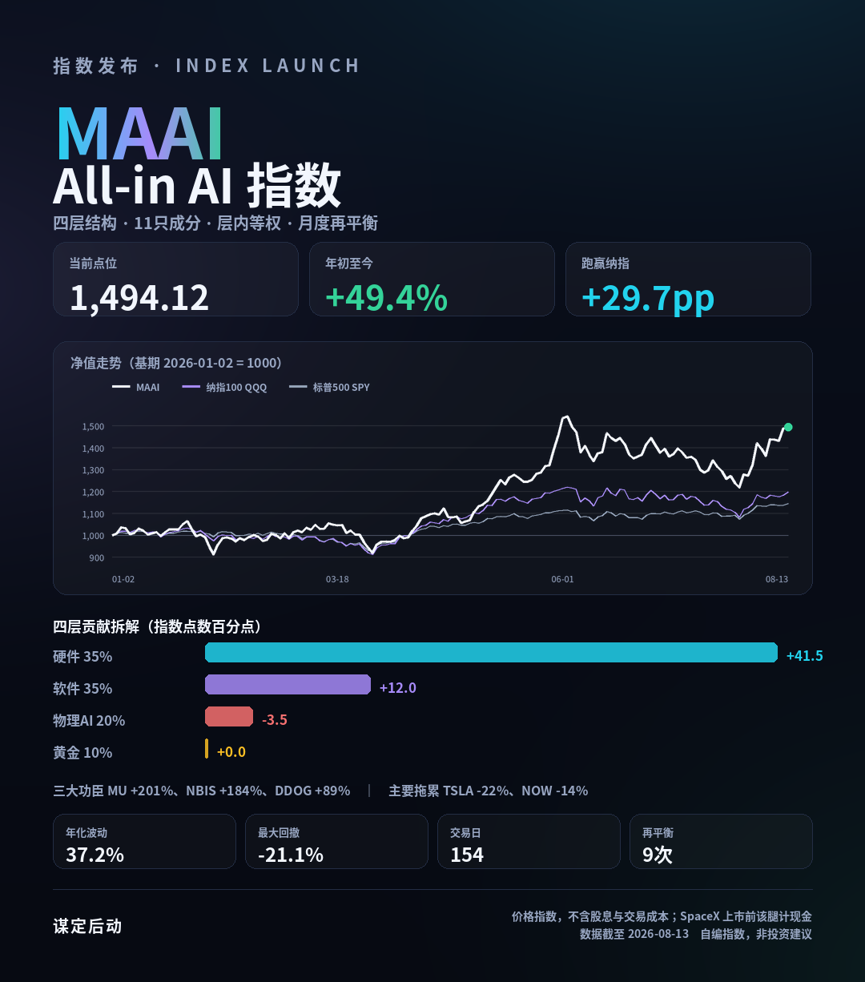
The benefit is flexibility. The MAAI index structured this way has risen 49.4% year-to-date, outperforming the Nasdaq by 29.7 percentage points: the hardware layer contributed 41.5 points, the software layer contributed 12 points, physical AI dragged down by 3.5 points, and gold remained flat. Key contributors: Micron +201%, Nebius +184%, Datadog +89%; drag: Tesla -22%, ServiceNow -14%.
The cost is volatility. Annualized volatility is 37.2%, with a maximum drawdown of 21.1% this year; it is not uncommon for us to drop 1.5% when the Nasdaq falls by 1%. More importantly, concentration: the four layers diversify the segments, not the narrative; all four layers are betting on the same narrative: continued AI capital expenditures. If major expenditures slow down, all three layers will be hit together, and the 10% gold serves as a cushion, not a lifeboat.
Fully invested in AI brings flexibility, but I am aware that what I pay is volatility. If you find this worth it, then choose to get on board.
4. 13F Wrap-Up: Where Big Money Stands
This Friday is the deadline for the Q2 13F filings. Goldman Sachs' hedge fund monitoring shows that entering Q2, hedge funds increased their net exposure to information technology by 853 basis points in a single quarter, the largest in history; semiconductor long positions reached a record 10% weight; typical funds have 72% of their long positions in their top ten holdings.
Let's look at one fund that just submitted its Q2 report: Dan Bin's Dongfang Harbor Overseas Fund, which reported a total of $1.65 billion and 13 holdings on August 10. During the quarter, it cleared positions in Apple, Tesla, and the triple Nasdaq ETF, while initiating positions in Intel, SanDisk, AMD, Marvell, ARM, and Broadcom; apart from the largest holding, Google, the top ten are all in the AI computing chain, with semiconductors and storage combined at 76.6%, and the storage duopoly of SanDisk and Micron accounting for 21%.
A veteran value investor who started with Moutai has transformed his portfolio into a full AI computing position in just one quarter, reflecting the concentration of consensus. He emphasizes computing power and storage, while we spread across four layers, betting more on software monetization and physical AI; the SanDisk we just cleared is now his fourth largest new position: the same main line, different rhythms.
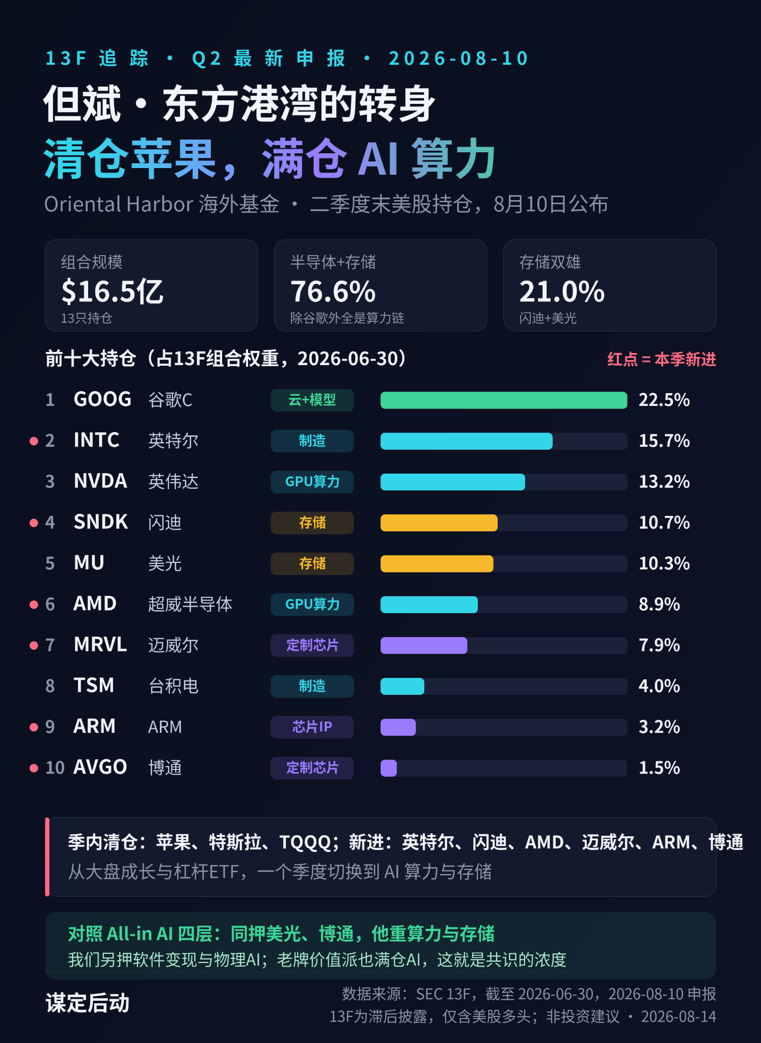
Big money moving in the same direction is good news, but crowding itself is a risk: the median short ratio of S&P 500 stocks has risen to 3% of market capitalization, the highest since 2011; hedge fund leverage is at the 94th percentile over five years. Entering through the same door means exiting through the same door, and those fully invested must always remember this.
5. MAAI Index Launch
Starting next week, this portfolio will officially be made into an index displayed on the website: MAAI, MOU All-in AI Index. The base date is January 2, 2026 = 1,000 points, latest at 1,494.12 points; 11 components, four-layer structure, equal weight within layers, with monthly rebalancing. Paid members can view daily updates and complete component weights of the index.
The only purpose of creating an index is to turn opinions into verifiable numbers, with both right and wrong displayed on the wall.
Seeing the big trend is only half the value; the other half is paid to those who can hold on.
The electricity revolution took forty years; many saw electricity, but few held onto it: those who bought electric stocks in 1901 had to endure the panic of 1907 and World War I. Money from trends has always been divided in two; seeing the big trend is only half the value, the other half is paid to those who can hold on.
Outlook for Next Week
Next week in the U.S. stock market will be a quiet review week before the big exam.
Macro-wise, we look at the July meeting minutes on Wednesday; for earnings, we will see Home Depot, Target, and Walmart, assessing consumer strength; AI will take a mid-game break. The real big test will be the week after next: NVIDIA's earnings on August 26 and the Jackson Hole annual meeting opening on August 27, one will set the tone for the AI narrative, and the other will determine the direction of interest rate paths.
Volatility usually converges before a big test, and there is no need to chase sudden spikes or drops; for those looking to add positions, save your bullets for around the NVIDIA earnings report.
[For specific operations and portfolio details, please visit the website: www.finplusplus.com\]
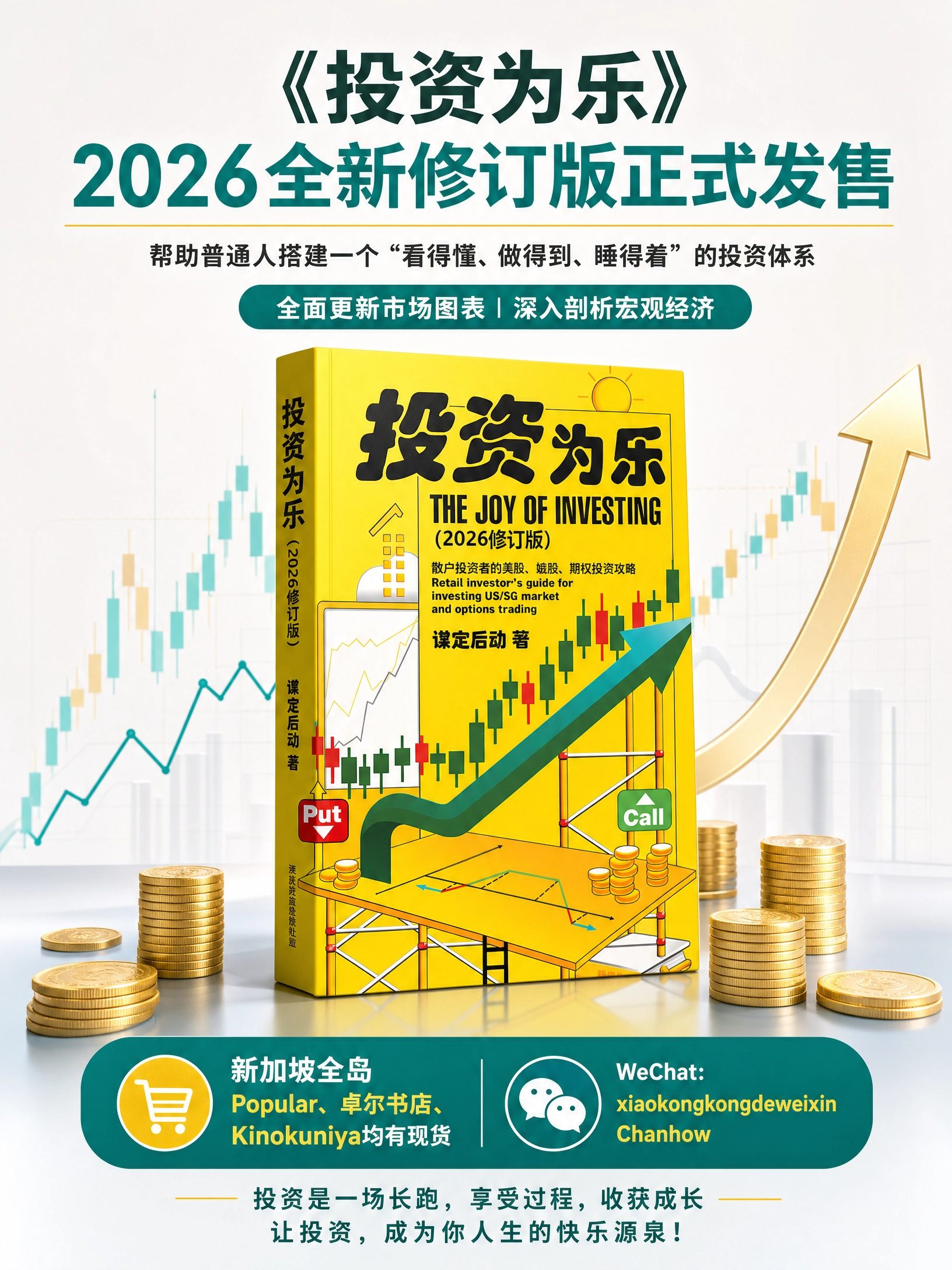
"Investing for Joy" 2026 Revised Edition
The new revised edition of "Investing for Joy" is officially on sale! This book does not promise to make you rich overnight; its core mission is to help ordinary people build an investment system that is "understandable, actionable, and sleepable." As a practical guide designed for working investors, it serves more like a good mentor, accompanying you in honing investment into a long-term, stable survival skill.
【Wechat Community】
Friends who love investing and options strategies, the WeChat group for MOU Community is full. You can add staff as friends with the note "MOU Community," and I will pull you into the group~

【WhatsApp Community】
【Free Group】 Discuss investment-related topics freely without worrying about sensitive word reviews.

- 【Muted Group】 MOU will share his pre-market operation ideas and real-time trading.
- 【Member Investment Group】 Limited to private teaching members, can communicate with various investment bigwigs, and can directly @MOU in the group for questions.
- 【Member Chat Group】 Limited to private teaching members, casual chatting and making friends, with no topic restrictions.
Official website finplusplus.com
- 【MOU Weekly】 and 【MOU Insights】 provide weekly updates analyzing various industry sectors.
- 【Real-time Sharing】 is first released on the official website, where you can search for all historical trades by MOU.
- 【Community】 freely initiate discussions, share investment insights, operational strategies, industry insights, and more.
