First, take a look at this screenshot. This is a closing order for selling Put options from my company's real account, with a profit of $44,392.

Seeing this image, most people's first reaction is: Micron has risen again. That's right, on 9/4, Micron closed at 1016, up 6.1% for the day. However, this profit has little to do with whether the stock price goes up or down. The Micron stock in this account had a cost of 1000, and the current price is 1016, which means the stock price has only moved 1.6% in four months. Over four months, the account's cumulative profit and loss for Micron reached $101,585, with $4,680 from stocks and $96,905 from options.
95% of the money comes from selling volatility, not from stock price movements.
Today, I will break down every transaction in this account related to Micron, from the first transaction on May 8 to this one on September 4, including the few losing trades in between. Many friends in our group face the same dilemma I did back then: a stock has risen from 315 to 747, more than doubling, and if you missed the opportunity, what can you do now?
May: An insurance policy priced one-third below the current price
On May 8, Micron closed at 747. It started the year at 315, rising 137% in four months. If you were to chase the stock at this level, it would be nerve-wracking, but there was something that rose even faster than the stock price: implied volatility.
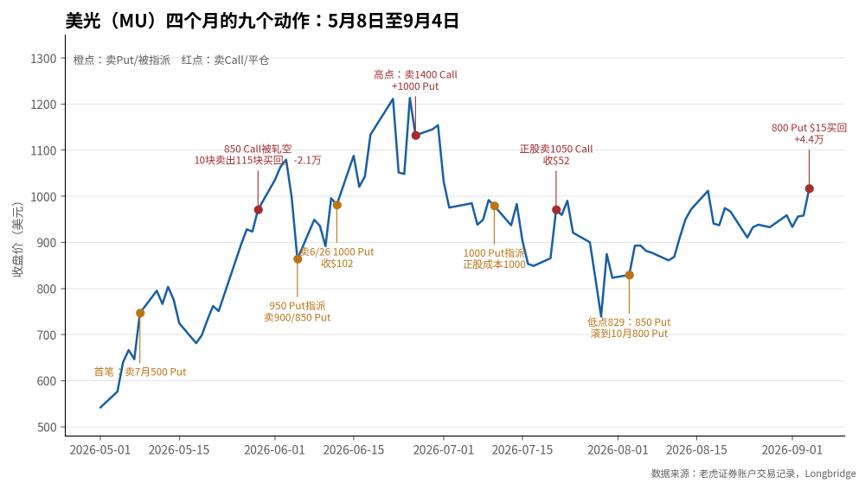
The price of options is essentially an insurance premium. The crazier the stock price, the more expensive the insurance. At that time, Micron's IV was over 70%, which meant that selling a July Put with a strike price of 500 could yield a premium of $28. The strike price of 500 was one-third lower than the current price. In other words, the market was paying you $28 per share, betting that Micron would not drop 33% in the next two months.
This was the first transaction in this account regarding Micron: instead of buying the stock, I sold insurance first.
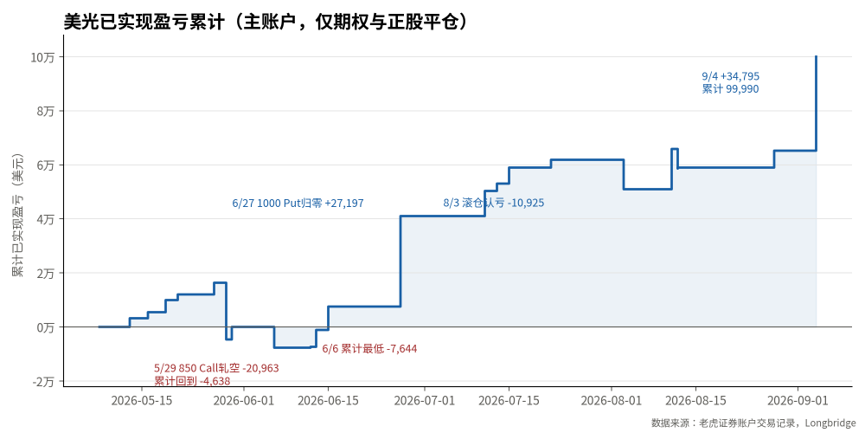
Throughout May, this 500 Put was rolled over twice; after a price increase, I bought it back and sold a closer one. Additionally, two short-term Calls far from the current price expired worthless. In total, by May 27, the account had made a cumulative profit of $16,000 from Micron, without holding a single share.
At the end of May: the short squeeze resulted in a loss of $21,000.
Then came the only significant loss of this round.
On May 21, with Micron around 760, I sold a Call with a strike price of 850 expiring on 5/29, collecting $10. The strike price was 12% higher than the current price, and the logic was that the probability of a 12% increase within a week was low. However, within a week, Micron surged from 760 to 970, a 27% increase, and that Call sold for $10 had to be bought back for $115. The single transaction resulted in a loss of $20,963, and the cumulative profit and loss for Micron in the account shifted from +$16,000 to -$4,638.
This transaction deserves special mention because it exemplifies the most typical failure mode of this strategy. Selling Put options profits from the "not dropping" scenario, with the risk being the obligation to buy the stock, which you still hold afterward; selling naked Calls profits from the "not rising" scenario, with the risk being unlimited, and betting on "not rising" with a stock at 70% IV is leaving yourself with the lowest probability direction. After this transaction, Calls on Micron in the account were only sold under two conditions: when holding the underlying stock or when the strike price was far enough from the current price.
June: A week of panic, premiums doubled
At the beginning of June, Micron fell from 970 to 864 in a week, a drop of 11%. The previously sold 950 Put was exercised, and on June 6, I closed it at a loss of $7,602. The cumulative profit and loss hit its lowest point at -$7,644.
However, another event occurred that same week: IV surged from 70% to over 90%. The sharper the drop, the more expensive the insurance, and the more the insurance sellers should act. On June 6, I sold an 850 Put, collecting $45; on June 12, when Micron rebounded to 981, I sold a Put with a strike price of 1000 expiring on 6/26, collecting $102. For two weeks of insurance, I received a 10% premium.
On June 27, this Put expired worthless, yielding a profit of $27,197, the largest single profit in these four months. The cumulative profit and loss for the account jumped from -$7,644 to +$40,000.
July: Accepting delivery at 1000, then immediately selling Calls
On June 25, Micron surged to a historical high of 1213. That day, I sold a 1400 Call and a 1000 Put expiring on 7/10, collecting premiums for both the rising and falling insurance. On July 10, Micron closed at 979, the 1400 Call expired worthless, and the 1000 Put was exercised, allowing the account to acquire the underlying stock at a cost of 1000.
This is how I ended up "entering Micron quite late, around 1000."
It is important to clarify one thing: being exercised is not the same as being "stuck"; it is the price I accepted when I sold the Put. Selling the 1000 Put for $23 means I committed to buying at 1000, with an actual cost of 977. After receiving the stock, I did not wait for it to rebound; on July 21, I directly sold an 8/21 Call with a strike price of 1050, collecting $52. I bought it back for $2.3 on August 11, making a profit of $14,905 in a month. The underlying stock had not yet recovered, but the Call had already reduced my cost to below 950.
August: Low point at 829, no cutting losses, just buying time
On August 3, Micron dropped to 829.5, the lowest point in four months. The underlying stock had a floating loss of 17%, and the 8/21 Put with a strike price of 850 was already deeply in-the-money; if I did nothing, I would have to take on another batch of stock on August 21.
The approach was to roll the position: I bought back the 850 Put for $99, realizing a loss of $10,925; at the same time, I sold a 10/16 Put with a strike price of 800, collecting $131. The loss was on the August leg, and the $131 premium collected bought me two months of time. If Micron returns above 800 in two months, that $131 will be pure profit; if it continues to drop, I will be buying at 800, which is $50 cheaper than 850.
On September 4, with Micron at 1016, I bought back that 800 Put for $15. The $44,392 shown in the screenshot is from this leg.
Three prerequisites, missing one means don’t learn
In four months, the main account had 60 transactions, with a cumulative profit and loss of $101,585. After breaking down the process, the three prerequisites for this strategy are clear:
First, a solid fundamental basis. Being willing to accept delivery at 1000 is based on the logic that HBM is in short supply and DRAM contract prices are continuously rising; this is something I have repeatedly discussed in the group. The premise of selling Puts is that you genuinely want to hold this company at that price; otherwise, the day you take delivery will mark the beginning of a disaster.
Second, IV must be high. Micron's IV has consistently ranged from 60% to 90% this year; for the same strike price distance, the premiums are three to four times that of Apple. If the same actions are applied to low-volatility stocks, the premiums collected may not be enough to cover the risks of taking delivery.
Third, the ability to withstand drawdowns. In late May, the cumulative floating loss was $25,700, and in early August, the underlying stock had a floating loss of 17%. The account was not forced to liquidate because there was room left in the Micron position. Entering at a high price is not a problem; being fully invested at a high price is the issue.
From one Micron to a basket of AI stocks
If this can be done with one Micron, what about a basket of stocks in this round of AI? This is the starting point for compiling the MAAI index.
For new friends who don’t know what MAAI is, let me clarify. The MOU All-in AI Index, code MAAI, is a price index we compiled ourselves, with a base date of January 2, 2026, equal to 1000 points. It consists of 13 constituent stocks, divided into four layers with fixed weights: 35% for hardware that sells shovels, 35% for software that monetizes, 20% for physical AI that positions itself, and 10% for precious metals that stabilize the portfolio. Each layer is equally weighted and rebalanced on the first trading day of each month.
Why four layers? The AI trend is not a single track; it consists of companies in four different stages rotating. The first half of the year was dominated by hardware, and after July, software began to take over, while physical AI has been waiting for catalysts. Focusing on just one layer can be very rewarding when it’s rising, but during rotations, it can leave you staring blankly. Putting all four layers together, the index itself is a combination that doesn’t require guessing who will take over.
Report card: On September 3, it closed at 1468.75 points, up 46.9% for the year, compared to QQQ's +17.3% and SPY's +13.8%. The cost must also be clarified: the maximum drawdown for the year was -21%, with an annualized volatility of 37%, more than twice that of QQQ. The returns come from volatility; this index is not suitable for those who cannot withstand a 20% drawdown.
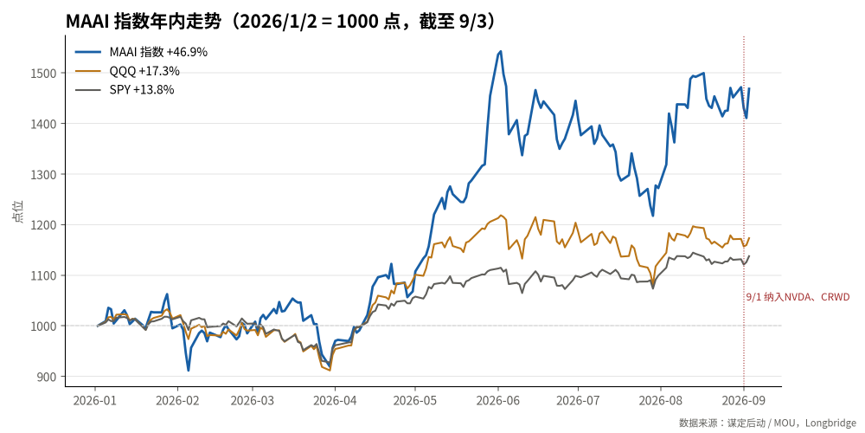
Attributing this year's performance, Micron alone contributed +204%, making it the top contributor to the index. Echoing the screenshot at the beginning: the stock that rose the most in the index is precisely the one that made money by selling volatility in the account.
This week, the index did two things. First, on September 1, it underwent a rebalance, adding NVDA to the hardware layer and CRWD to the software layer, with five stocks in each layer. Second, it formed a V shape: it fell to 1411 on Tuesday and Wednesday, then recovered all losses on Thursday with a +4.09% gain, with the software layer contributing 2.64 points and SNOW contributing 1.12 points.
Commentary on Constituent Stocks
Starting from this issue, I will regularly comment on a few constituent stocks each week, discussing their fundamentals and the corresponding actions in the account. I will only discuss actions and logic, not positions.
NVDA
On the day of the earnings report, it surged nearly 9%, only to give back half the gains the next day. The earnings numbers were solid, with revenue doubling and a gross margin of 75%, but the issue is that everyone knows the numbers are good, so after the rise, it naturally needs to take a breather. This week, I did something simple: I didn’t chase the big bullish candle from the earnings report, but instead waited for it to pull back and bought two June 200 Calls. Why buy Calls instead of the underlying stock? Because the Calls are cheaper now.
SNOW
On the day after the earnings report on Wednesday, it skyrocketed 16%, making it the biggest gainer among the constituent stocks this week. The core point is this: money is starting to flow into software in this AI wave, and Snowflake is the most direct beneficiary, as the more it is used, the more it is paid for. The account took two actions. The day before the earnings report, I bought back the October Put that I had already made a decent profit on, and replaced it with a sold Put expiring that week, betting not on the rise or fall, but on the volatility collapsing after the earnings report. After the earnings surge, I sold a January 400 Call. This isn't bearish; after a 16% rise, I wanted to lock in some of the gains.
TSLA
The worst performer in the index this year, down 14%, actually rose 8% this week, ranking among the top three gainers. Why? There’s no new story; it simply dropped too much before, and now the physical AI line is starting to attract attention again. The account's action was set up on August 23: I placed a sell order for a June 600 Call at $18. It was posted for 11 days and executed on Thursday at $376. It’s not that I predicted Thursday would be the high point; I had already thought through that at this price, I was willing to sell the space above 600, leaving the rest to the market.
Reminding of risks does not mean being bearish.
The biggest risk of selling Puts is not taking delivery; it’s continuing to drop after taking delivery. On August 3, when Micron was at 829, was a rehearsal for this. If I hadn’t had the room to roll the position, the outcome would have been being forced to take delivery at the lowest point and cutting losses. The index's -21% drawdown is also a real occurrence, not just backtested. This issue details the two losing trades more than the profitable ones, which is the point.
Pullbacks are not scary; they are when IV is highest and insurance is most expensive. As long as the fundamentals remain unchanged, pullbacks are the best entry opportunity for those selling insurance, not a signal to retreat.
What the market buys is never predictions, but your capacity to endure during panic.
The stock price is given by the market, while the premium is earned by yourself. Making $100,000 from Micron bought at 1000 is not because I predicted the direction correctly, but because I sold insurance to others when they were most afraid.
Outlook for Next Week

[For next week's outlook and specific position details, please visit the website: www.finplusplus.com\]
(All trading records in this article come from the author's own account and are for review purposes only, not constituting any investment advice; selling options carries risks of taking delivery and unlimited losses, please make decisions based on your own risk tolerance.)
"Investing for Joy" 2026 Revised Edition
The 2026 new revised edition of "Investing for Joy" is officially on sale! This book does not promise to make you rich overnight; its core mission is to help ordinary people build an investment system that is "understandable, doable, and sleepable." As a practical guide specifically designed for working investors, it serves more like a good mentor and friend, accompanying you in honing investment into a long-term, stable survival skill.
Investing, honing a long-term skill
The 2026 new revised edition of "Investing for Joy" is now officially on sale.
Investing is not just about ups and downs and profits and losses; it is also about how to establish a method that suits you in a busy life.
This practical guide, designed for working investors, does not promise overnight wealth but accompanies you in building an investment system that is understandable, doable, and sleepable, allowing investing to become a skill that can be refined over the long term.

Find friends to discuss investing together
WeChat · MOU Community
If you want to exchange investment insights and discuss options strategies, feel free to join the MOU Community. The existing WeChat group is full; you can add the staff's WeChat and note "MOU Community," and the staff will arrange for you to join a new group.

WhatsApp · Free Investment Discussion Group
Discuss the market, strategies, and thoughts and confusions along the investment journey. Friends who love investing are welcome to join, freely exchange ideas, and learn together.

For more in-depth communication, welcome to learn about VIP services
If you wish to continuously follow MOU Teacher's market observations, operational ideas, and real trading records, and want to engage in deeper discussions with more investment enthusiasts, you can learn about FinPlusPlus VIP services.
Member community
• Operation sharing group (mute group): Concentrated viewing of MOU Teacher's pre-market thoughts and real trading operations, reducing information interference.
• Member investment group (limited to private teaching members): Exchange with fellow investors, and you can directly @ MOU Teacher for questions.
• Member chat group (limited to private teaching members): Discuss life and make friends outside of investing.
Website content and community
• MOU Insights · MOU Weekly: Continuously follow market dynamics and industry sector analysis.
• Real trading sharing: First published on the official website, supporting the retrieval of historical trading records for easy review and analysis.
• Investment community: Share investment insights, operational strategies, and industry observations, initiating discussions on topics of interest.
Learn about VIP services →
Official website:
finplusplus.com
Communication and real trading sharing are for learning reference only and do not constitute investment advice. Make independent judgments and act according to your capacity.
