Let's not talk about grand theories for now, but rather look at a past event.
In the week of December 17, 2018, the Federal Reserve raised interest rates on Wednesday, and Friday was quadruple witching day, just like next week. This rate hike was already priced in, with the market pricing in a probability of over 70% before the meeting. As a result, the S&P 500 fell 7.05% for the week, and the Nasdaq dropped 8.36%, marking the worst week since 2011.
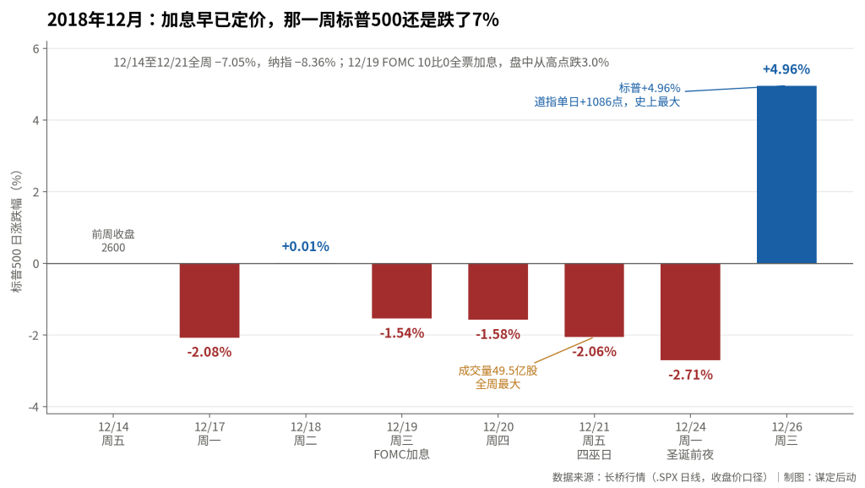
Three details are worth our attention.
First, no one was surprised by the rate hike itself. What caused the market to crash was Powell's statement at the press conference that "the balance sheet reduction is on autopilot and will not change." The market had already digested the rate hike, but not his unwillingness to compromise.
Second, the vote was 10 to 0. The committee was not divided at all, yet the market still fell 7%. In comparison, from 1957 to 2013, dissenting votes accounted for only 6% of all votes; there were zero dissenting votes in 2000 and 2004. In December 2025, there were 3 dissenting votes against a rate cut; on July 29 this year, it was 9 to 3, with Hammack, Kashkari, and Logan all calling for an immediate rate hike, all hawkish. The level of division is at a high not seen in nearly a decade. But 2018 taught us that a unified committee can still cause a market crash, and a divided committee is even more likely to do so. So don’t guess how the market will react; you can’t predict it, just prepare for it.
Third, the +4.96% candlestick on December 26. Four months later, the S&P returned to its previous high. Those who liquidated their positions on Christmas Eve took the full hit of the drop and missed out on the subsequent rise.
Positioning for Next Week Based on the Week of 2018
My advice to members is as follows: my account's leverage ratio has returned to below 1.1, and I will actively reduce it further next week, closing all Sell Puts while keeping the underlying stocks and Calls unchanged, and adding Sell Calls for hedging.
Let’s compare this to the scenario in December 2018, item by item.
Leverage below 1.1: A 7% drop in the index means a high-beta account could reasonably drop by around 10%.
Closing all Sell Puts: This was the most lethal position during that week in 2018. The VIX doubled within a week from its pre-meeting low, with the SP facing pressure from both ends, leading to a drop multiplied by Delta, and a further hit from the doubled IV. Currently, IV is low, making it cheaper to close SP positions; buy insurance when premiums are low, not when the house is on fire.
Keeping the underlying stocks and Calls unchanged: You need to be present when lightning strikes. I remain strongly bullish on AI's prospects; my long-term positions will not change due to a single rate decision.
Adding Sell Calls: It won’t make much money, but it did one thing that week, as detailed below.
The Original Intention of Sell Calls
Some may ask: With IV so low, the premiums from selling Calls are so thin, what’s the point?
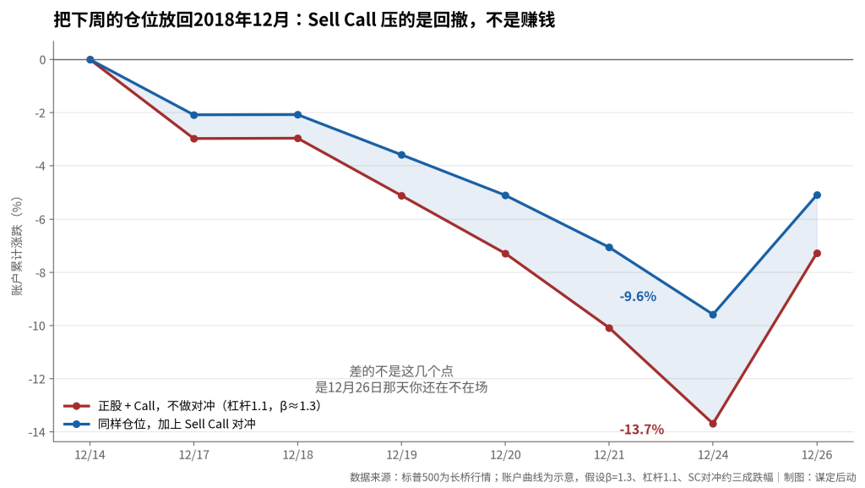
It’s not about the money. In this account, SC has never been a tool for income; it serves two purposes.
The first purpose is to mitigate losses. The Delta of SC is negative, meaning it profits when the underlying stock drops, effectively adding an automatic partial reduction to the entire position. The sharper the drop, the smaller the Delta, and the higher the hedging ratio. If the underlying stock drops by 10%, SC can cover two to three points, reducing the account drawdown from 10% to 7%.
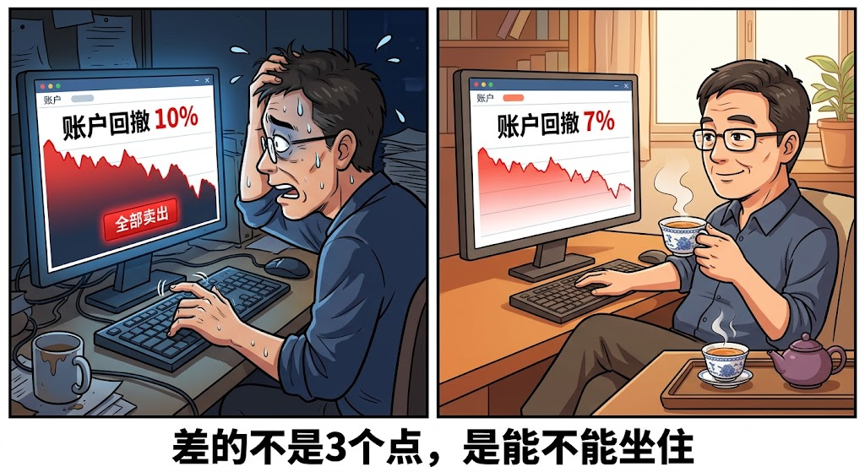
The second layer, also the original intention: mindset. A drawdown of 7% versus 10% may seem like a difference of just 3 percentage points, but the psychological impact is not linear. With a smaller drawdown, you can afford to do nothing on December 26; with a larger drawdown, you might liquidate on December 24 and then stare blankly at the bullish candlestick on the 26th. SC is not about income; it’s about the qualification to "stay put."
What If I’m Wrong?
The second question: What if the market rises significantly after the rate hike?
Let’s do the math. Missing out on a 5% rise means you need another 5% to make up for it. If you take a 15% drawdown, you need a 17.6% rise to break even, and with a leveraged account, that’s even more. Losses and recoveries are never symmetrical, so the costs of hedging and accidents are also asymmetrical.
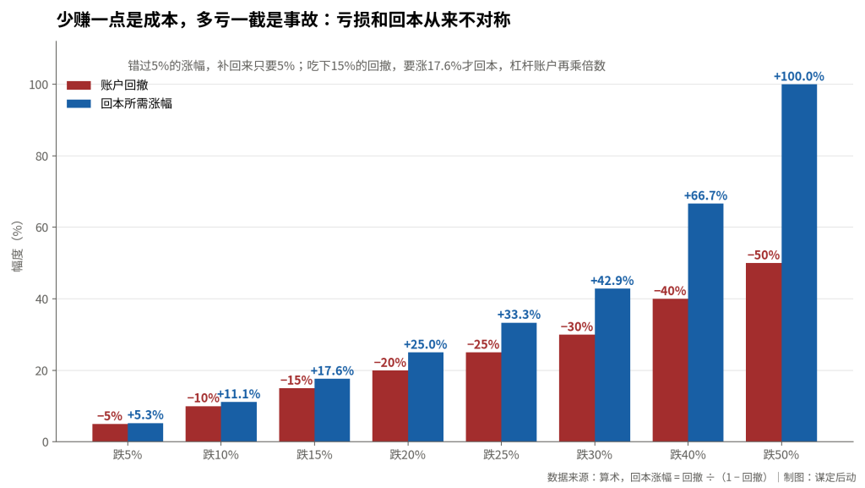
Now, let’s talk about operations. If a Call is exercised, just buy it back; who can capture all the gains? The portion you miss out on is a clear cost recorded in the books. The portion you lose is an accident, and accidents cannot be budgeted.
After December 26, 2018, the S&P regained its previous high within four months. The ones who truly missed the market were not those who hedged that week, but those who were forced out by the drawdown.
At 2 AM on Wednesday, Look at Three Things
At 2 AM Singapore time on Thursday, the decision will be announced. A 25 basis point rate hike to 3.75% to 4.00% is already largely priced in. The variables are in three areas:
The dot plot’s implication for December. Deutsche Bank predicts another hike in December, bringing it to 4.00% to 4.25%. Among the 18 members in the June dot plot, 9 supported a hike within the year; let’s see where this median shifts.
Dissenting votes. In July, there were 3 dissenting votes; if this time it exceeds 3 votes or if there are dovish dissenting votes, it indicates a shift in the committee’s division from "to hike or not" to "which direction."
Warsh’s characterization of inflation. With May CPI at 4.2% year-on-year, energy contributed over 60%. Blaming oil prices means admitting it’s a supply shock, which would reduce hawkishness; conversely, it could be more hawkish. The rate hike itself is not important; the reasoning behind it is what matters.
Closing Thoughts
In the week of December 2018, everyone knew there would be a rate hike, but no one expected a 7% drop. Knowing and preparing are two different things.
Hedging is not about being bearish; it’s about buying yourself the right not to make a decision on the worst day.
Outlook for Next Week
Next week is bound to be a week of significant volatility.
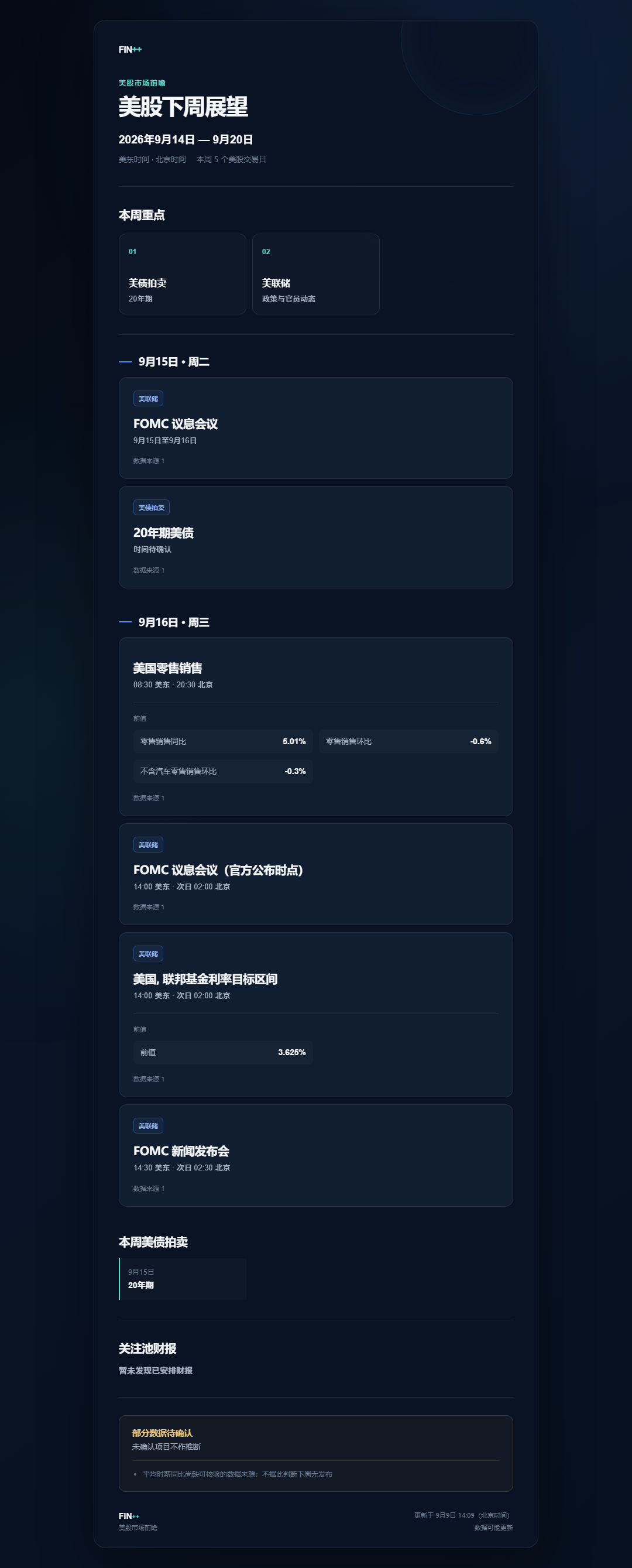
On Wednesday, the Federal Reserve's decision will be announced during U.S. trading hours, followed by the Bank of England on Thursday and the Bank of Japan on Friday. Friday is also quadruple witching day, with quarterly options, futures, and index options all expiring simultaneously. With three central banks and an expiration date crammed into four days, volatility will only amplify, not diminish.
Reminding of risks does not equal being bearish; a pullback is an opportunity to get on board, provided you still have a ticket.
[For specific operations and position details, please visit the website: www.finplusplus.com\]
This article represents personal views and probability assessments and does not constitute investment advice. Data sources: S&P 500 and Nasdaq daily lines are based on Long Bridge quotes (closing price basis); FOMC votes in December 2018, and June and July 2026 FOMC votes and dot plots are based on Federal Reserve announcements and reports from CNBC and Yahoo Finance; historical dissenting vote statistics are from the St. Louis Fed; Figure 2 account curve is illustrative, assuming β=1.3, leverage 1.1, and SC hedging approximately covering 30% of the drop.
Investing, Cultivating a Long-Term Skill
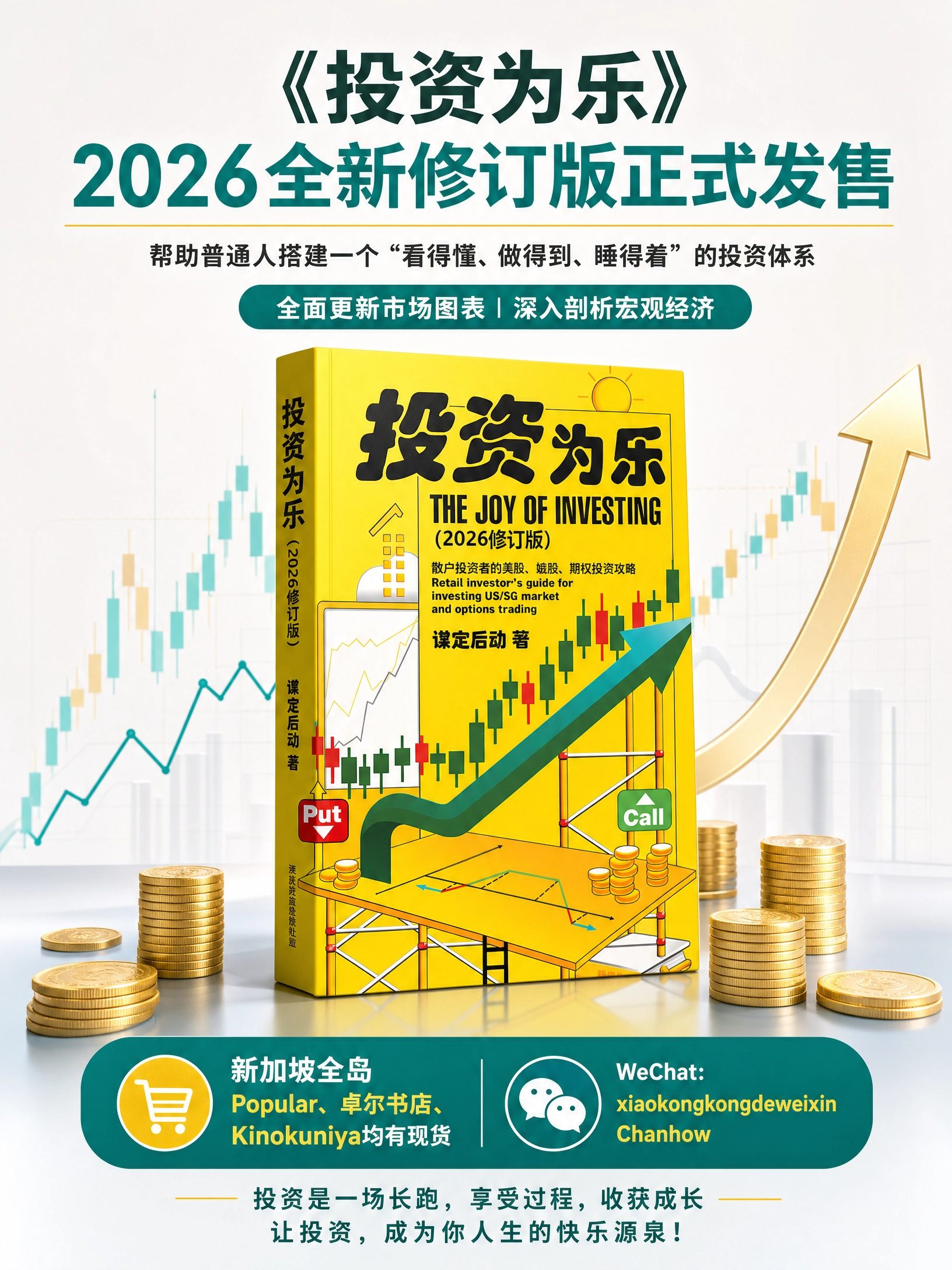
The newly revised edition of "Investing for Joy" 2026 is now officially on sale.
Investing is not just about rises and falls and profits and losses; it’s about how to establish a method that suits you in a busy life.
This practical guide is designed for workplace investors, not promising overnight wealth but accompanying you in building an investment system that is understandable, actionable, and allows for restful sleep, turning investing into a skill that can be refined over the long term.
Find Friends to Discuss Investments Together
WeChat · MOU Community
If you want to share investment insights and discuss options strategies, welcome to join the MOU Community. The existing WeChat group is full; you can add staff on WeChat, noting "MOU Community," and staff will arrange for you to join a new group.

WhatsApp · Free Investment Discussion Group
Discuss the market, strategies, and thoughts and confusions on the investment journey. Friends who love investing are welcome to join, freely exchange ideas, and learn together.

For More In-Depth Communication, Welcome to Learn About VIP Services
If you wish to continuously follow MOU Teacher's market observations, operational ideas, and real trading records, and want to engage in deeper discussions with more investment enthusiasts, you can learn about FinPlusPlus VIP services.
Member Communities
• Operation Sharing Group (Mute Group): Concentrated viewing of MOU Teacher's pre-market thoughts and real trading operations, reducing information interference.
• Member Investment Group (Private Teaching Members Only): Exchange with fellow investors, and you can directly @MOU Teacher for questions.
• Member Chat Group (Private Teaching Members Only): Chat about life and make friends outside of investing.
Website Content and Community
• MOU Insights · MOU Weekly: Continuously follow market dynamics and industry sector analysis.
• Real Trading Sharing: First published on the official website, supporting the retrieval of historical trading records for easy review and replay.
• Investment Community: Share investment insights, operational strategies, and industry observations, and initiate discussions on topics of interest.
Learn about VIP services →
Website registration:
finplusplus.com
Communication and real trading sharing are for learning reference and do not constitute investment advice. Make independent judgments and act within your means.
