On August 15, 1971, Nixon held a closed-door meeting at Camp David for an entire weekend and announced to the nation on Sunday evening: the dollar was decoupled from gold. In the years prior, central banks lined up to exchange dollars for gold from the United States, with France even sending warships to transport it. The whole world was waiting for a grand show of "America can't pay anymore." In the end, that show did not take place; instead, another unfolded.
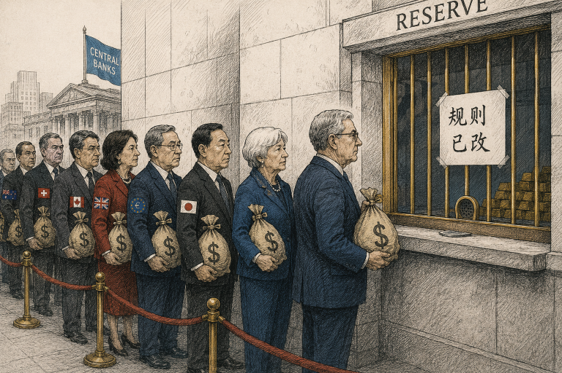
Why tell this old story? Because 55 years later, this week, with $40 trillion in national debt, long-term interest rates hitting a 19-year high, and the Treasury personally stepping in to buy bonds, the public has begun another countdown. This issue lays out the accounts to see why Wall Street is paying real money.
I. Market Review: The Treasury Has Stepped In
Three key events on the table this week. On August 18, the yield on 30-year U.S. Treasuries reached 5.34%, the highest since 2007. On August 20, total federal debt surpassed $40 trillion. Sandwiched in between was the most critical event: on August 19, Treasury Secretary Yellen announced plans to at least double long-term bond repurchases, buying over $40 billion in two months, stating the goal was to "make a market" for long-term bonds.
The market's reaction was quite honest: on that day, the 30-year yield dropped by 9 basis points, only to rebound two days later. The painkiller was effective for just two days.
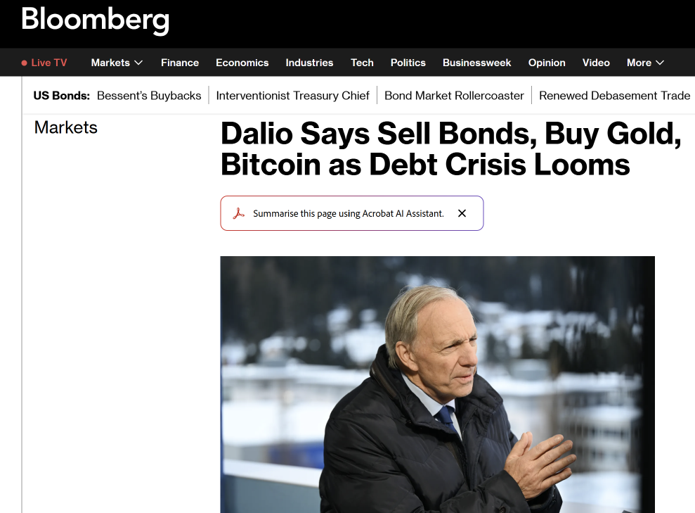
Then on August 21, Dalio posted on LinkedIn: without structural adjustments, the U.S. could face a sovereign debt crisis within about three years, fluctuating within two years, suggesting reducing bond holdings and allocating 10% to 15% into gold. This statement was widely circulated by global media and became the source of all panic this week.
II. The Accounts: For Every $100 in Tax Collected, $21.5 Goes to Interest
Let’s set aside opinions and look at the numbers. After 10 months of the fiscal year, the figures are as follows: revenue of $4.485 trillion, up 3%; expenditures of $6.283 trillion, up 5%; a deficit of $1.798 trillion, with the CBO estimating a total deficit of $2.1 trillion for the year, resulting in a deficit rate of about 6.5%. This level of deficit has only appeared historically during wartime and deep recessions.
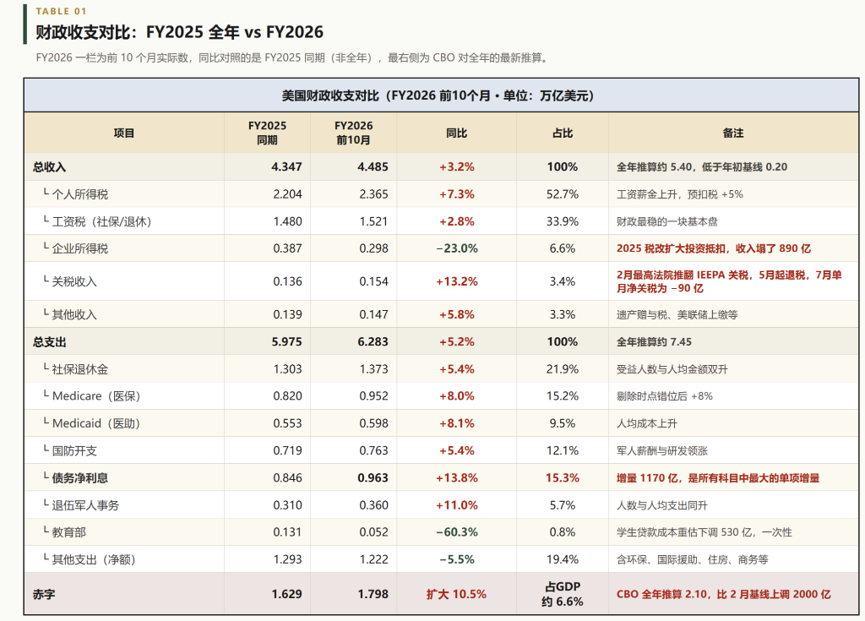
On the revenue side, two pillars have collapsed. On February 20 this year, the Supreme Court ruled that IEEPA tariffs were illegal, leading to refunds starting in May, totaling about $100 billion; in July alone, refunds of $36 billion exceeded collections of $26 billion, turning tariff revenue negative. The CBO directly slashed its annual tariff forecast by $250 billion. The other pillar is corporate income tax, which, due to last year's tax reform expanding investment deductions, saw a year-on-year decrease of 23%. The story of "tariff revenue skyrocketing by 153%" from last year is essentially dead this year.
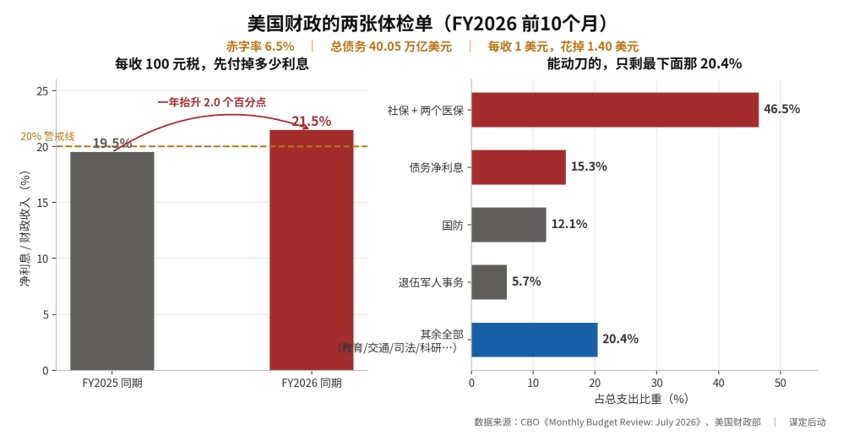
The real protagonist on the expenditure side is interest. In the first 10 months, net interest payments totaled $963 billion, an increase of $117 billion year-on-year, the largest single increase among all categories, surpassing the increases in Social Security, Medicare, and defense. The proportion of interest in fiscal revenue rose from 19.5% in the same period last year to 21.5%, crossing the 20% warning line set by most institutions.
What’s more troubling is that this process will accelerate automatically. The average interest rate on existing debt is only 3.45%, while the market yield on 30-year bonds is already at 5.34%. When old debt matures and is replaced with new debt, interest automatically jumps a level; no new bad news is needed—just time can widen the gap.
In the expenditure structure, Social Security and the two Medicare programs account for 47%, interest accounts for 15%, and defense accounts for 12%, leaving only 20% politically feasible for cuts. Even if that 20% were entirely eliminated, it wouldn’t cover the 6.5% deficit rate. To put it bluntly: this country is currently spending $1.40 for every $1 it collects.
III. Why Wall Street is Paying
When opinions are flying everywhere, look at the prices. Three sets of prices are more useful than a hundred comments.
The first set is long-term bonds. The New York Fed has an indicator called the term premium, which simply means "the extra compensation required for borrowing long-term." It is currently at 0.80%, compared to a negative 1.36% in 2020, having recovered over 200 basis points in five years, reaching the highest level since 2011. JPMorgan's report on August 19 bluntly stated: the Treasury's repurchase "only treated the symptoms, not the root cause; the root cause is a 6% deficit in an economy close to full employment," and provided a hard number: the financing gap over the next few years exceeds $3.5 trillion. A Bloomberg survey of 392 professionals found that two-thirds believe the 10-year yield will break 5% this year, and 60% believe the debt issue will worsen to trigger a major crisis.
The second set is gold and the dollar. Central banks bought 289 tons of gold in the second quarter, setting a record for a single quarter, totaling 345 tons in the first half of the year. Fund managers continue to short the dollar and cluster into gold. This is central banks insuring their dollar assets.
The third set is the most interesting: default insurance. There is a type of contract in the market that specifically bets on whether a country will default; if it does, it pays you money. The current price for buying this insurance on U.S. Treasuries is 42 basis points, which is low and cheaper than last year.
When these three sets of prices are put together, the answer emerges: the market is willing to pay for "higher interest," willing to pay for "the dollar becoming worthless," but unwilling to pay for "America defaulting." The panic is real, but the content of the panic is not what the headlines suggest. Dalio's own prescription actually confirms this point; he does not recommend fleeing U.S. assets but rather buying gold.
IV. When to Really Worry: Three Switches
Dalio states that to judge a debt crisis, three things should be considered, and we will go through them one by one.
Interest relative to fiscal revenue: 21.5%, crossing the line, red light. The scale of bond issuance compared to buying: the 30-year yield is at a 19-year high, and the main buyers entering the market now are hedge funds and institutional money, not foreign central banks; this type of money is very price-sensitive, red light. The third point, central banks printing money to buy bonds: not triggered. This time, it is the Treasury stepping in, not the Federal Reserve; $40 billion is a drop in the bucket compared to the tens of trillions in the market. However, in nature, this is the first step of the Treasury reaching in to suppress interest rates, which is worth monitoring closely.

From now on, keep an eye on these three switches; if any two are turned on simultaneously, it signals a transition from a chronic condition to an acute outbreak: Treasury repurchases continuously expanding from the $40 billion level; the Federal Reserve being forced to restart bond purchases; the 30-year yield stabilizing above 5.5%. Additionally, as a corroborating sign, if the 42 basis point default insurance starts moving towards 80, it indicates a market shift.
Before these three switches, all "countdowns" are just emotions.
V. Practical Strategy: Don’t Catch the Falling Knife of Long Bonds, Don’t Bet on the Timing of the Explosion
Three sentences frame the strategy, with details discussed in the group.
Do not bottom fish long bonds. When old debt is replaced with new debt, interest automatically rises a level, which is unrelated to market sentiment; 5.34% is not proof that it has "peaked." For yield, short bonds are just as attractive, and there’s no need to catch the long-duration falling knife for a little extra interest.
Use gold as insurance, not as a bet. Central banks are buying, Dalio is advocating, and prices are around 4500; this insurance is no longer cheap. Its allocation significance remains, but chasing high prices is not meaningful.
For tech holdings, focus on the denominator. Long-term rates are the denominator for all high-valuation assets; if this line is unstable, valuations will have a ceiling. Keep existing positions unchanged and wait for the denominator to stabilize. In a high-volatility environment, continue to collect rent through CC; the higher the option premium, the higher the waiting wage.
Conclusion
Returning to the initial question. The central banks that lined up to exchange for gold in 1971 ended up receiving every penny, and the U.S. did not default for a single day. However, over the next decade, the price of gold rose from $35 to $850, and the dollar depreciated by half against the mark. The creditors received the same number of bills, but each bill became thinner.
So the question "Will U.S. Treasuries default?" has already been answered by the market. The five-year default insurance (CDS) for U.S. Treasuries costs only 42 basis points per year, so cheap that no one takes it seriously. It does not tell you that nothing will happen; it tells you that what happens will not be this. Those fixated on the countdown to default will always miss the explosion point and, in waiting, miss the entire pricing process.
There is no need to fear a default; fear the ability to pay.
Finally, a reminder: Dalio's judgment is not new this week. In 2015, he said a repeat of 1937 was coming; in 2016, he said the debt supercycle was ending; in 2018, he predicted a recession within two years; in 2022, he warned of a perfect storm; in 2023, he mentioned a debt crisis; and in 2025, he predicted an explosion within three years. Those who liquidated based on his words over the past decade missed the largest bull market in U.S. history. He himself has admitted that in 1981-1982, he misjudged the U.S. entering a depression, which became the biggest lesson of his career. Last June, he published a book titled "Why Nations Go Bankrupt," which he is still promoting globally this year; warnings themselves are his product. Saying this is not to deny him; the accounts are the accounts, and the speakers are the speakers. The direction he points out is correct; he just made the timeline too specific.
Next Week’s Outlook
Next week’s U.S. Treasuries should be watched by words, not actions. The Jackson Hole annual meeting is about to start, and Federal Reserve Chair Powell's speech will be the focus: his previous stance was to let market rates do the Fed's work; this time, facing the Treasury's intervention to suppress rates, will he acquiesce or draw a line? This will directly determine the direction of long-term rates. On the data side, watch PCE; oil prices are still at $87, and if inflation does not stabilize, long bonds will not have a decent rebound.

For specific operations and holding details, please visit the website: www.finplusplus.com
